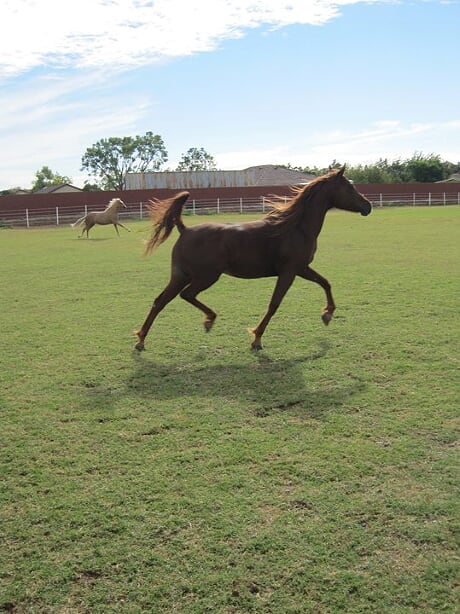
Like a herd of painted ponies, friends are the color in life’s kaleidoscope.
They don’t arrive all at once, and they don’t stay in formation.
Some move through quietly. Others burst in, bright and unforgettable. A few linger long enough to feel like part of the landscape.
The people we meet along the way come in all personalities. Some are lasting. Some are transient. All of them leave a mark—one of remembrance or a lesson.
Some friendships are easy. They settle in naturally, without effort or expectation. You pick up where you left off, no matter how much time has passed.
Others arrive with intensity—fast, vibrant, consuming—only to fade just as quickly. At the time, they feel significant. Later, you realize they were never meant to stay.
And then there are the ones who challenge you.
The ones who reveal something you didn’t want to see. The ones who test your boundaries, your patience, your sense of self. They don’t always leave gently, but they leave something behind—clarity, strength, or the quiet understanding that not every connection is meant to last.
It’s easy to measure friendship by duration. The ones who stayed. The ones who didn’t.
But time isn’t always the measure.
Some of the most fleeting connections leave the deepest impressions. A conversation. A moment. A shared experience that shifts something in you, even if the person is gone just as quickly as they arrived.
Like a kaleidoscope, the pattern is always changing.
Pieces move. Colors shift. What once felt central fades to the edges, while something new comes into focus. You don’t always see the full design while you’re in it.
Only later do you recognize the pattern—the way each person added something, even if it was brief.
Some brought warmth. Some brought laughter. Some brought lessons you wouldn’t have chosen, but needed all the same.
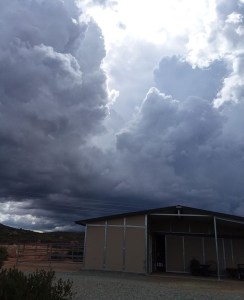
They feel it long before the sky changes—before the first drop, before the first sound of thunder.
The air shifts. The energy changes. The herd knows.
And they move.
We’re not built that way.
We get the warning… and stay anyway.
There’s always a moment.
It’s usually quiet. Subtle. Easy to dismiss if you’re not paying attention.
Something feels off.
Not wrong in a way you can explain. Not enough to walk away. Just enough to make you pause—if you let yourself.
Most of us don’t.
We explain it away. We soften it. We give it the benefit of the doubt. We tell ourselves we’re being too sensitive. Too cautious. Too quick to judge.
So we stay.
The first signal is rarely loud.
It doesn’t arrive with certainty or clarity. It shows up as discomfort. A hesitation. A shift in energy you can’t quite name.
Like the air changing before a storm.
And almost instinctively, we override it— because walking away early feels unreasonable, because we don’t have proof, because we want to believe the best.
But the truth is simple, even if we don’t like it:
We knew.
Not everything. Not how it would unfold. Not how far it would go.
But we knew enough.
There’s a cost to ignoring that moment.
It’s not always immediate. Sometimes it takes time to surface.
It shows up in small ways at first—unease, tension, the sense that you’re adjusting yourself to fit something that doesn’t quite align.
Then it grows.
You find yourself explaining behavior you wouldn’t normally tolerate. Making space for things that feel uncomfortable. Silencing your own reaction just to keep the peace.
And little by little, you lose your footing.
We don’t just ignore red flags.
We negotiate with them. We rewrite them. We minimize them. We convince ourselves they mean something else.
But the signal doesn’t change— only our willingness to listen.
Looking back, the clarity is always there.
The moment you hesitated. The thing that didn’t sit right. The feeling you pushed aside.
It was never unclear.
It was just inconvenient.
We sabotage our equilibrium every time we step into a situation that feels off from the start.
Learning to trust that first signal isn’t about becoming guarded or closed off.
It’s about staying aligned with yourself— about recognizing that discomfort isn’t something to override… it’s something to understand.
Because in the end, the lesson isn’t about what someone else did.
There are places in the world where animals watch you. And then there’s the Galápagos— where they don’t.
There’s no fear in their eyes. No instinct to run. No sense that you don’t belong. You’re not observing wildlife. You’re stepping into their world.
Quito felt like an introduction… but not the destination.
The Marriott was familiar, predictable — a place to land before stepping into something I couldn’t quite picture yet. The next day brought the expected stops — the equator line, the views, the market, a lunch that felt more staged than real. It was interesting, even enjoyable, but still within the rhythm of travel. Structured. Explained. Designed for you.
It all made sense.
Until it didn’t.
Somewhere between Quito and the islands, the world shifted.
Smaller plane. Fewer people. More distance between things. Less noise. Less urgency.
By the time we boarded the Celebrity Xpedition, it was clear this wasn’t going to be a typical trip. The ship didn’t feel like a destination — it felt like access. A way in.
In the Galápagos, the rules are simple — and enforced.
You don’t wander. You don’t touch. You don’t interfere.
Every visitor is accompanied by a licensed naturalist. The ecosystem is protected with an almost reverent discipline, and because of that, the animals remain exactly as they were meant to be — wild, undisturbed, and completely indifferent to human presence.
And that indifference is what makes the experience so extraordinary.
We explored the islands twice a day for a week — one excursion in the morning, one in the afternoon.
Each outing felt like stepping into a different world.
One moment you’re walking along a rocky path beside marine iguanas, the next you’re standing quietly while a sea lion pup studies you with curious, unguarded eyes. Birds nest at your feet. Crabs scatter across volcanic rock. Life unfolds all around you, uninterrupted.
There is no performance. No reaction. No need for you at all.
I wasn’t prepared for how close everything would be.
Not just physically — although that alone was surreal — but something deeper.
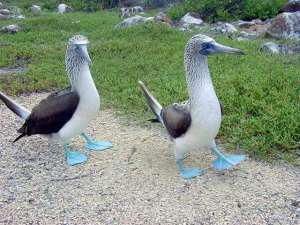
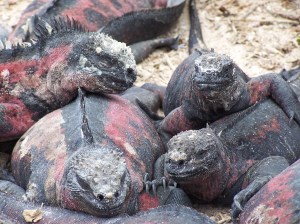
The blue-footed boobies walked past like we didn’t exist. A sea lion blinked slowly, unimpressed by my camera hovering inches away. Marine iguanas gathered in clusters, ancient and unmoved.
It wasn’t that they trusted us. It was that they had never learned not to.
There was one moment that stayed with me — simple, unexpected, and oddly meaningful.
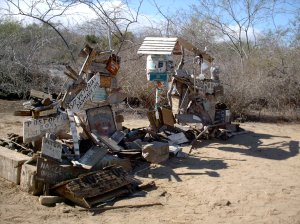
We stopped at what they call the “post office” on Floreana Island.
Not a building. Not a mailbox.
Just a weathered barrel surrounded by driftwood signs from travelers who had passed through before us.
We were each given a postcard and asked to write a message to ourselves — name and home address included.
Then came the part that made it unforgettable.
We were told to sort through the stack of postcards left behind… find one addressed to someone who lived near us… and take it home to deliver.
No stamps. No system. Just trust.
My husband’s postcard arrived first — hand-delivered by someone we now refer to only as “Blood Bank Bob.”
Mine showed up later, quietly, like it had always belonged there.
And somehow, it meant more than anything sent the traditional way ever could.
At the time, I didn’t understand what I was seeing.
The marine iguanas looked almost prehistoric — dark and unmoving against the volcanic rock — until you noticed the color. Not subtle… but vivid. Reds and greens woven through their scales like something alive beneath the surface.
Later, I learned we had arrived just as the breeding season was beginning.
Even here, in a place that feels untouched by time, there are rhythms quietly unfolding — whether you recognize them or not.
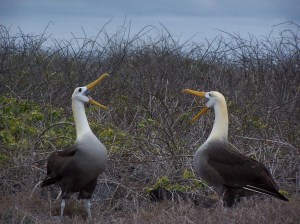
And then there were the albatross.
Before the cliffs… before the flight… there was something quieter.
Pairs stood facing each other, calling, moving in sync — a kind of ritual that felt both ancient and deliberate. There was no audience. No urgency. Just connection.
They bond for life.
We watched as they moved through these small, repeated gestures, as if reinforcing something already understood.
And then, later, at the edge of the cliffs, they gathered again — this time facing the wind.
One by one, they stepped forward.
A pause. A shift.
And then — without hesitation — they launched into the air.
Even in the harbor, nothing really changed.
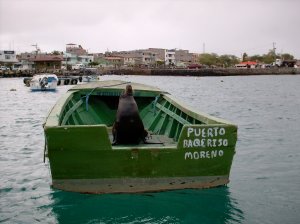
The sea lions claimed boats like they owned them, lounging without concern, completely indifferent to the activity around them.
There was no boundary between wild and human life — just a quiet understanding of who truly belonged.
Not everything in the Galápagos lives in the light.
Deep inside the lava tubes, where the air cools and the world goes quiet, we found an owl — perfectly still, perfectly aware.
It didn’t move. It didn’t flinch.
It simply watched us… as if we were the ones out of place.
The Moment That Stayed
It was an instinctive click. I didn’t plan it. I didn’t frame it. I didn’t ask. I just reacted.
The moment that stayed with me wasn’t a landscape or a sea lion or a postcard view.
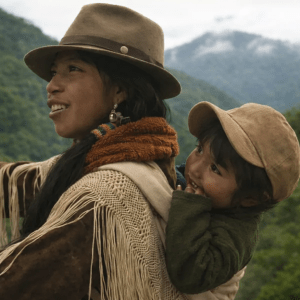
It was a woman at a hillside market, working with her child tied to her back.
She moved with a rhythm that belonged entirely to her life — unhurried, unposed, untouched by the presence of a stranger with a camera.
No one looked at me. No one performed.
I was invisible.
And somehow, that’s what made it matter.
It wasn’t a moment created for me. It was a glimpse of something real — offered without intention — and it stayed with me in a way I didn’t expect.
Sunshine, my first horse, was an absolute angel. I made all my early mistakes with her, and she tolerated every one of them with patience and grace. She lived to 35 and guided me through the early years of horse ownership with a temperament that could calm any storm.
She was loving with people, gentle with the herd, and willing in every task. Wherever we boarded, Sunshine became the sweetheart of the barn. She taught me the rhythm of partnership, the importance of consistency, and the quiet power of empathy.
When Sunshine suffered impaction colic and passed away, I was heartbroken. Rosie, her companion at the time, suddenly needed a new herd mate — and I needed a way forward. That loss opened the door to the next chapter: Sunrise.
Rosie: The Difficult Fireball
Rosie had been labeled untrainable. Eight owners in eight years had given up on her, and she was on the brink of being sent to auction. I bought her to spare her from that fate, fully aware she was a project — and fully unaware of how much she would change me.
Her early life had left its mark. She was reactive, protective, and deeply sensitive. Even simple tasks like touch or hoof care could trigger resistance. But behind all that fire was intelligence, intuition, and a fierce will to survive.
Her first breakthrough came with the farrier. After a disastrous initial visit, he refused to trim her without sedation. Two failed attempts later, I convinced him to work with Koelle, our equine trainer. Within an hour, Rosie lifted her hooves calmly and consecutively — a moment that felt like witnessing a miracle.
Rosie’s intuition was extraordinary. She read energy with precision.
The day I arrived at the barn after my accident — disheveled, injured, and emotionally raw — she recognized it instantly. She nickered loudly, nuzzled me gently, and made it clear she knew something was wrong. She didn’t need touch to understand vulnerability.
Through years of partnership, Rosie taught me patience, awareness, and the kind of trust that must be earned, not assumed. She forced me to slow down, to listen, and to show up consistently.
Sunrise: The Companion Who Chose Me
After Sunshine’s passing, Rosie needed a friend. That search led me to Sunrise, an eight-year-old Peruvian Paso mare who had been rescued and professionally trained.
Sunrise was everything Rosie wasn’t — calm, brave, steady, and deeply attuned to her rider. On her first day, we performed join-up in the round pen. She approached me directly, stopped in front of me, and the rescue owner said, “She just chose you.” And she had.
Her past had been difficult. She and her lifelong companion, Conquistador, had been rescued from neglect. But she had also been trained in California, competing successfully and earning ribbons at the Pomona Championship Horse Show.
Watching Sunrise and Rosie together was its own kind of education. They were different in every way, yet somehow balanced one another. Over time, their relationship shifted, and so did Rosie’s confidence.
Sunrise became my trusted trail horse — calm, protective, and reliable. She taught me the value of steadiness, intention, and quiet leadership.
Lessons from the Herd
Each horse taught me something different, something essential:
Sunshine taught consistency, grace, and the foundation of partnership.
Rosie taught resilience, intuition, and the courage to set boundaries.
Sunrise taught stability, bravery, and the quiet strength of reliability.
Together, they reshaped my understanding of connection, communication, and presence.
Horses speak through energy, not words. They respond to intention, not performance. They mirror our emotional truth whether we want them to or not.
The Enduring Gift of Horses
Even after their passing, their lessons remain. Rosie’s intuition, Sunshine’s patience, and Sunrise’s quiet strength continue to guide me — in relationships and in life.
Horses are not just animals. They are teachers, companions, and mirrors of our emotional selves.
Their gift endures — in memory, in wisdom, and in the way I move through the world.
Today marks the first anniversary of my husband, David’s, death. In the quiet moments, my heart still aches. My inner goddess continuously persuades me to get out and enjoy life. She who cannot be ignored wisely infers that no one leaves a lasting imprint by tiptoeing through life.
In the early weeks following David’s death, the stillness woke me. In the dark of night, I understood why people feared silence. His memory invaded my every thought. It was like a wicked form of torture. I went through the motions of daily life feeling like the walking wounded. I still hear his voice in my head scolding or encouraging. We knew each other so intimately that he would have a thought at the same time I verbalized it. I know exactly what he would say to me in every instance. It is comforting to feel David’s presence.
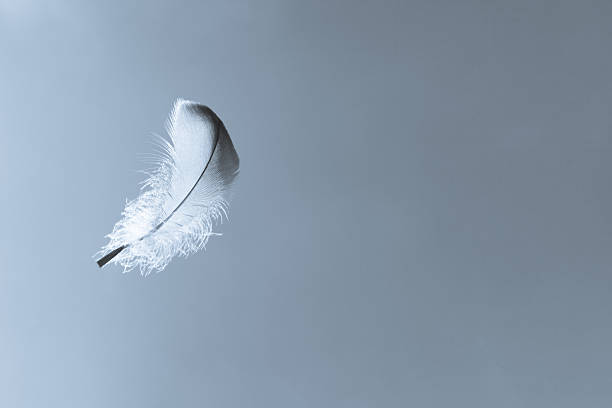
I planned to spend this weekend on a healing ride through Monument Valley with a Navajo guide named Joe. Unfortunately, the Tribal Park is closed due to the Covid-19 outbreak. Instead, I spent a quiet morning with my horses. While snuggling my palomino, Sunrise, a small grey feather floated in space, landing near my feet. The feather was noticed earlier in the week but disappeared. As if on cue, it reappeared today. Twirling in the breeze, it eventually landed on the toe of my fringed moccasin. Native Americans believe the feather is a powerful symbol. Feathers arrive unexpectedly, but always with purpose. When a feather falls to earth, it carries a message to a living being. The feather brings inner strength from a loved one. The symbolism is overwhelming and the hair stands up on my arms and neck.
Until you experience indelible loss, you cannot understand what it does to a person’s soul. Life can be painful and heart-rending. The pain of loss is immeasurable. The most devastating endings usher in the next chapter in life. Over the last year, intense grief has become profound sadness. There comes a moment when you realize everything has changed.
I truly believe people come into our life with purpose. The people we meet along the path teach us lessons, help us to grow emotionally, and force us to realize special moments. There are no mistakes or failures, just an evolution in time. Each chapter in life teaches us what doesn’t work; thereby, forcing us to focus on what we need.
A year has passed, yet here I sit with tears streaming down my face. It is through grief that we learn to value the present. Each of us is the architect of our life story. Every chapter must be worth reading.