I was born on October 22, which puts me at the very end of Libra, close enough to Scorpio to keep things interesting.
Most of the time, I’m very much a Libra girl.
I’m friendly. Social. Charming when the occasion calls for it. I like people, conversation and laughter. I prefer harmony over conflict and will usually try diplomacy before drawing a sword.
But I was born on the cusp.
That means the sword is available.
Aesthetics Matter
Libra is ruled by Venus, which supposedly explains our alignment with attractive surroundings.
In my case, this is entirely accurate.
I appreciate a well-planned outfit. I notice color combinations and whether an accessory enhances the look or has staged a hostile takeover.
But I’m equally comfortable dressed for an elegant evening or making a grocery run in barn clothes. To me, style is about balance. It’s wearing what you love, what fits the moment, and doing it with confidence.
The same applies to my home. I like contemporary and beachy, but I also want something unexpected—an antique piece in one corner and a hanging basket chair in the other.
Paws, Hooves & Priorities
Every Libra girl I know is an animal lover. For many of us, our children have always had paws or hooves.
Each one arrived with quirks, opinions, and a lesson I didn’t know I needed. They made me laugh harder than most humans ever could—and broke my heart when it was time to say goodbye.
They left pawprints on my floors, hoofprints in my pastures, and lasting imprints on my heart.
If you don’t like animals, the Libra in me will try to understand.
The Scorpio in me may quietly reconsider your invitation.
The Scales Must Consider Everything
Libras are often described as being indecisive. I call it due diligence. A Libra’s scales were never meant to tip without evidence.
It may not always be the right decision, but it will have been thoroughly considered.
Peaceful—Up to a Point
I don’t enjoy confrontation. I’ll explain, compromise, reconsider, and give people more chances than they probably deserve.
I prefer to keep things pleasant.
But there is a boundary.
It may take me a while to reach it because I’ve examined the situation from both sides, turned it upside down, and given everyone the benefit of the doubt.
Once I finally set that boundary, however, it isn’t drawn in pencil.
That may be the Scorpio in me.
The charming Libra greets you at the door. The Scorpio quietly installs the lock.
Another Year, A Little More Edge
Another birthday. A little more perspective. Still occasionally thrown off balance.
When necessary, I’ll let that Scorpio edge make an appearance.
Preferably, I’ll be wearing a fabulous outfit while I restore the balance.
Cheers to the October Girl—still balancing the scales, but unafraid to tip them when necessary.
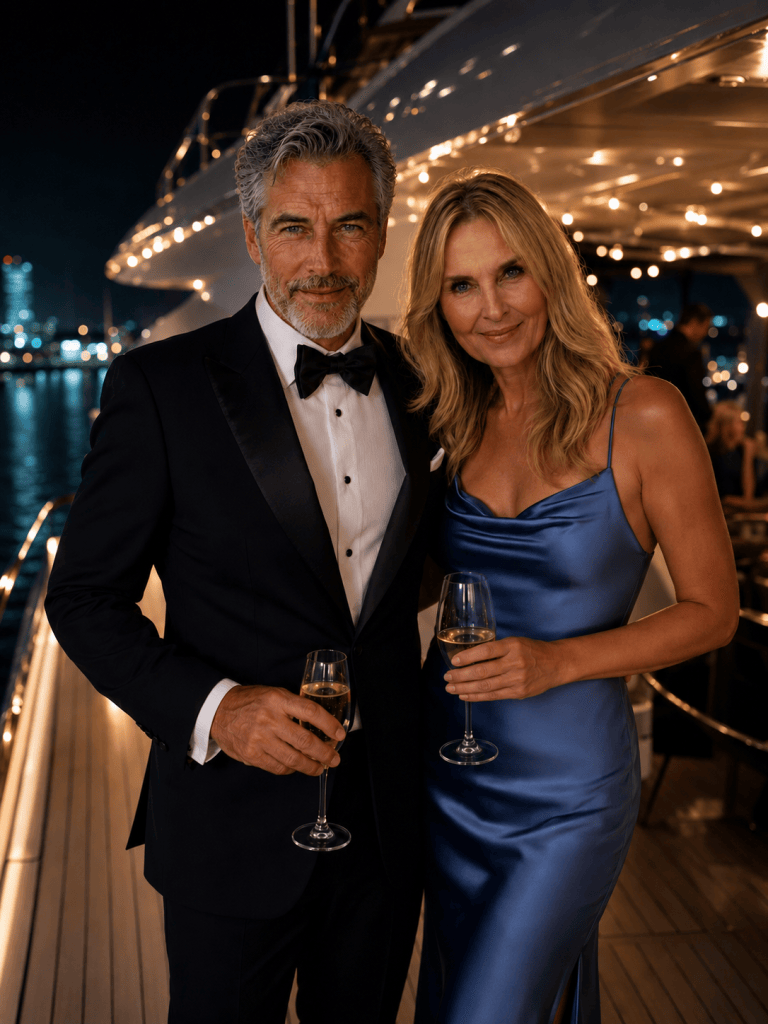
I was working in my home office when my phone pinged. It was Nick—“Mr. Fixit,” who I recently met in Key West. His guest for a charity event in Palm Beach had canceled, leaving him with an extra invitation to a black-tie cocktail cruise on the Intracoastal.
Palm Beach After Dark
Nick picked me up at the hotel around 8:30. The yacht wasn’t a floating palace owned by a mysterious billionaire — just one of the charter boats that glide up and down the Intracoastal.
Soft music. Servers with trays of tiny appetizers. Cocktails. The lights of Palm Beach shimmered across the water.
It was sophisticated, with just the right blend of elegance, charm, and coastal ease.
Rooftop Respite
It was close to 11 when Nick dropped me at the hotel. It had been a memorable evening, filled with engaging conversations and the opportunity to meet several local artists.
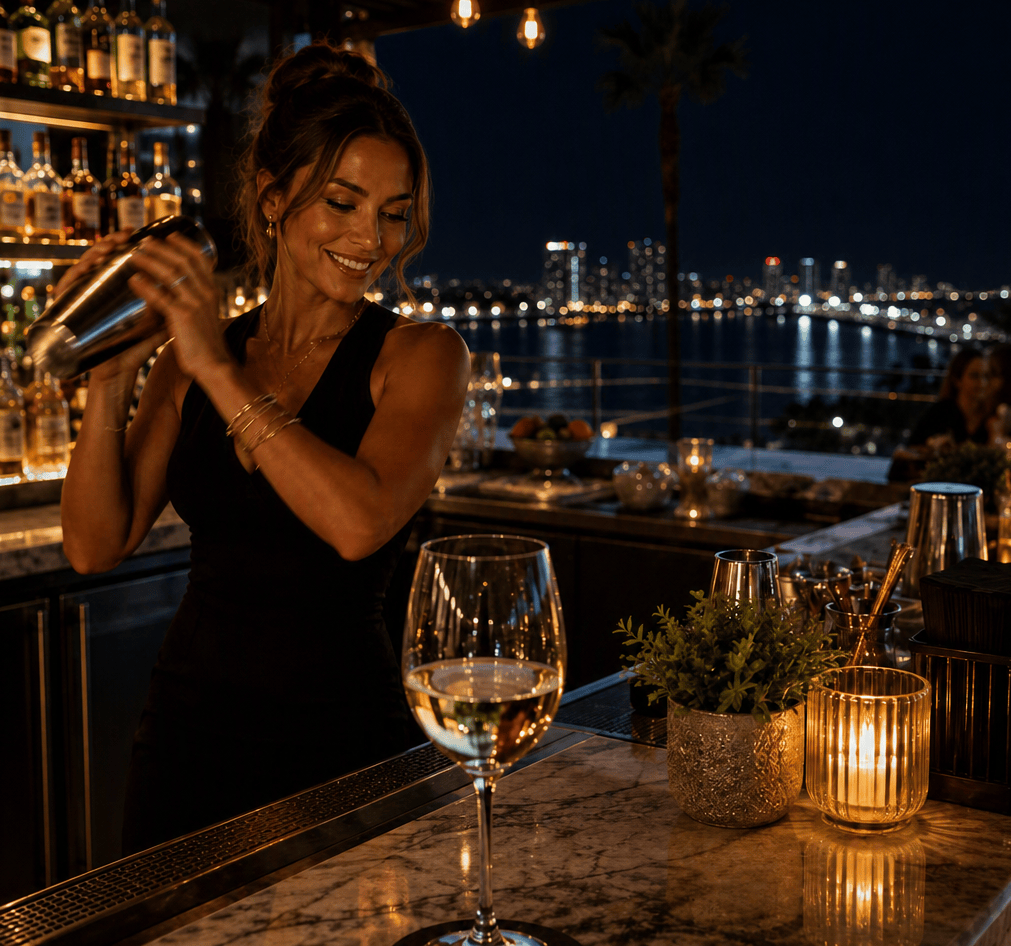
In the lobby, I headed for the elevator. Instead of pressing my floor, I decided to venture up to the rooftop bar to see the nighttime view I’d heard so much about.
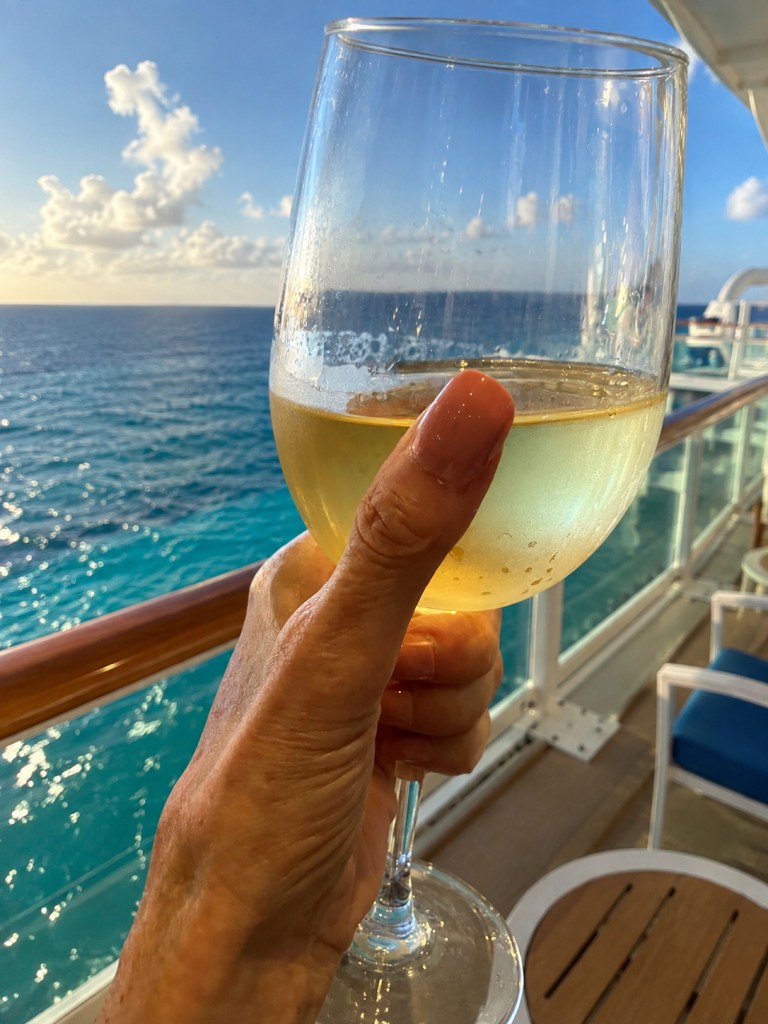
My bartender, Marisol, set a chilled Chardonnay in front of me and smiled. “That dress really makes your blue eyes pop.”
We chatted. She asked if I was in town for the weekend. I asked for Sunday suggestions. By the time I finished my wine, I had the beginnings of a plan.
Sunday Off Leash
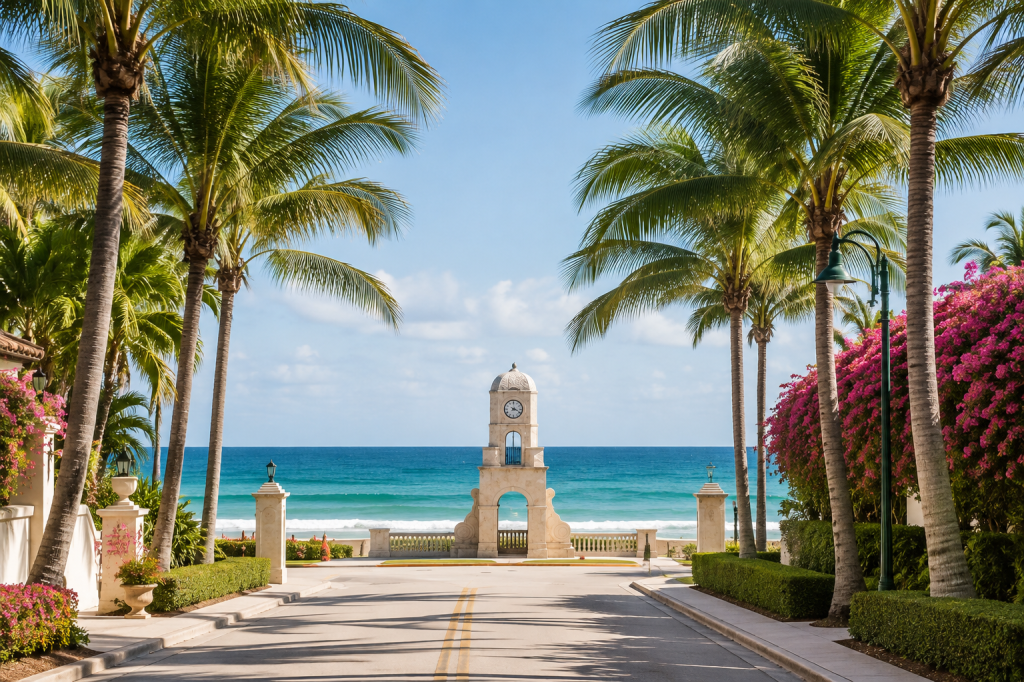
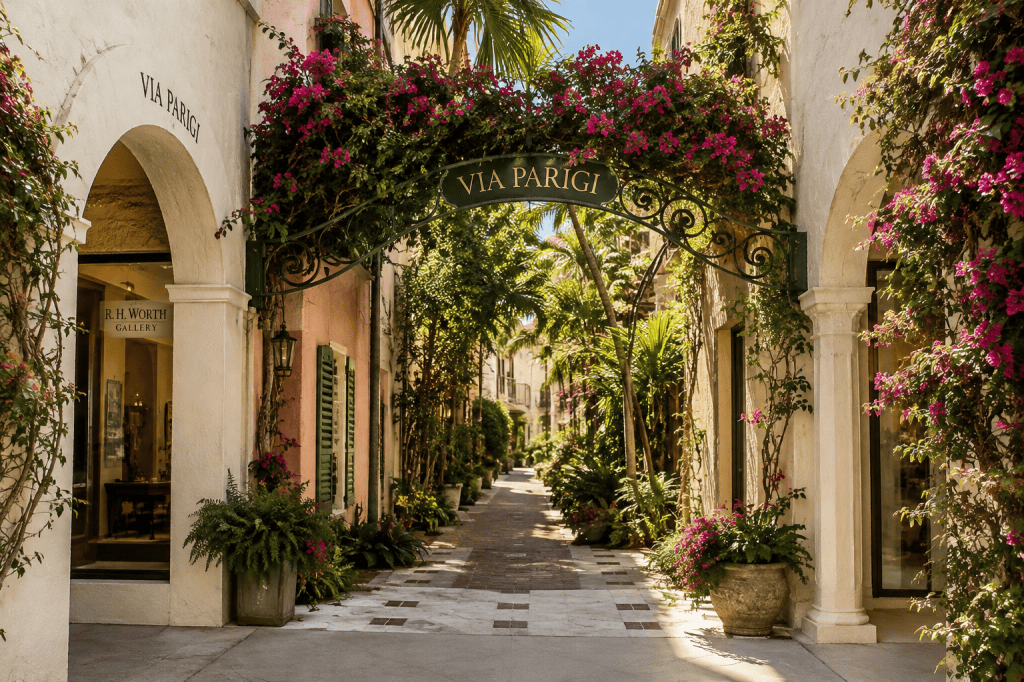
Sunday morning started at the Society of the Four Arts—gardens, shaded paths, and quiet corners—before I eventually wandered toward Worth Avenue.
Palm Beach has a reputation for wealth and glamour, but it was the architecture, flowers, hidden vias, and tucked-away galleries that made me stop and wander back for another look.
This is what I love about traveling alone: Nobody is waiting. Nobody is asking when we’re leaving. Nobody cares if I spend ten minutes photographing a doorway.
I can turn left simply because something looks interesting.
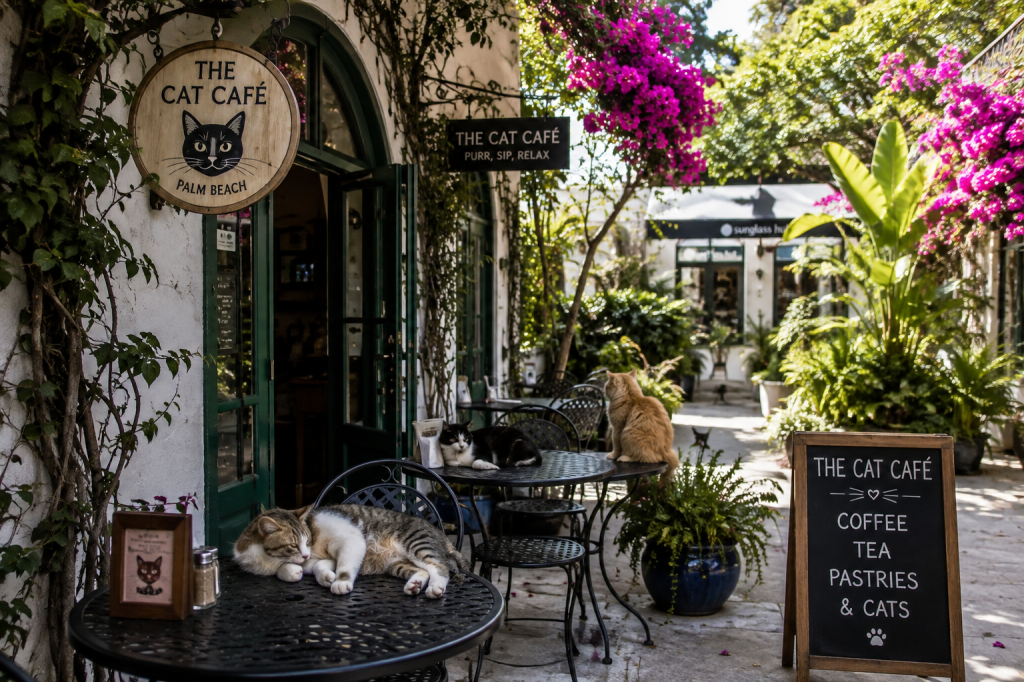
Which is how I eventually spotted a cat café.
There was no universe in which I was walking past a room full of cats.
Chaos at the Café
The feral little felines had ignored me completely until they caught a whiff of chicken. Suddenly, I was the most popular woman in Palm Beach.
As I reached the last few bites of my sandwich, one cat approached. Another noticed the first cat and apparently decided he was missing out on something important.
He jumped onto the table.
The iced tea never stood a chance.
The entire glass tipped directly into my lap. Not a splash. Not a few discreet droplets. The entire iced tea.
I froze. The cats scattered. Their work here was done.
The server rushed over with napkins. I blotted. She brought more. At this point, I wasn’t drying anything. I was just moving the iced tea around.
Ice cubes had taken up residence in my pockets.
I had no choice. I had to walk back to the hotel looking like I’d had an unfortunate incident.
Sunglasses on. Chin up. Down Worth Avenue I went.
Palm Beach personified approached — perfectly coiffed, perfect sandals, head-to-toe Lilly Pulitzer. She glanced at my pale pink shorts, then offered a knowing little smile.
I wanted to scream, No! It’s iced tea!
But dignity sometimes requires silence.
After the Chaos
By the end of the weekend, I realized Palm Beach hadn’t asked me to be perfect—it had simply invited me to show up.
Maybe that’s the real charm of these unsupervised little adventures. When things go sideways—and somehow, they always do—straighten your sunglasses, keep walking, and enjoy the story as it unfolds.
After all, perfectly planned weekends are rarely the most memorable.
A beach reset in Naples, Florida, takes an unexpected turn.
Only in Naples can you buy cucumbers, order a steak dinner, and dance to DJ music under the same roof.
I went to Naples looking for a coastal reset.
Sunshine. A little shopping. A walk along the Gulf. Maybe a nice glass of wine.
Nothing dramatic.
And for most of the trip, Naples cooperated.
Tin City
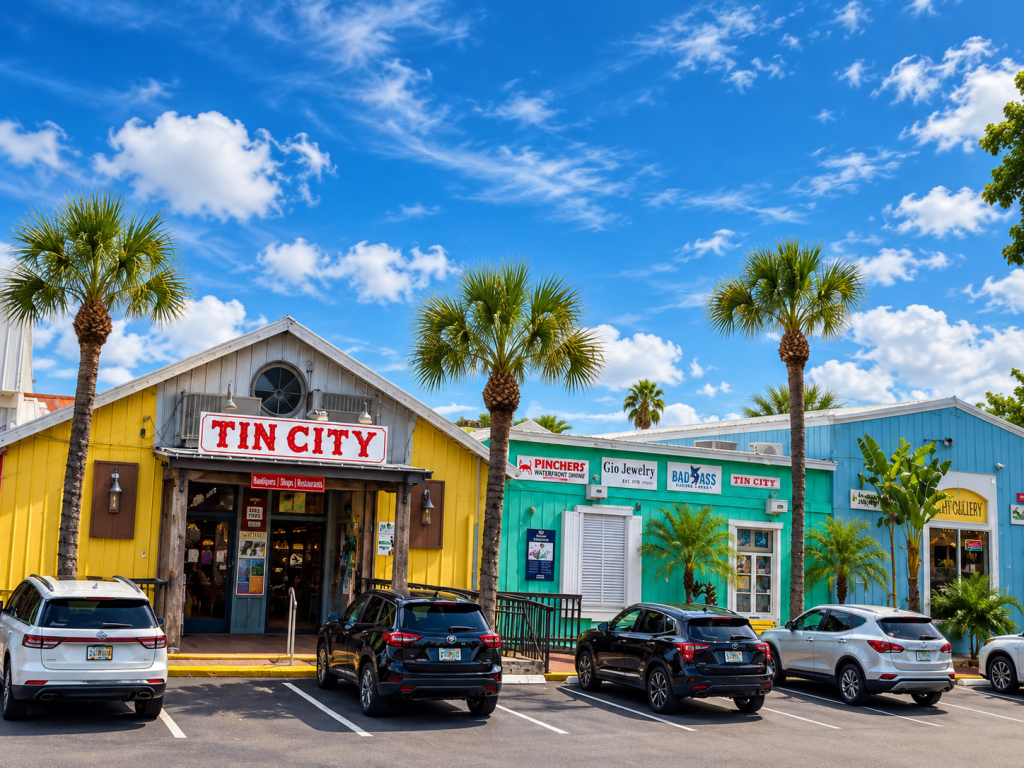
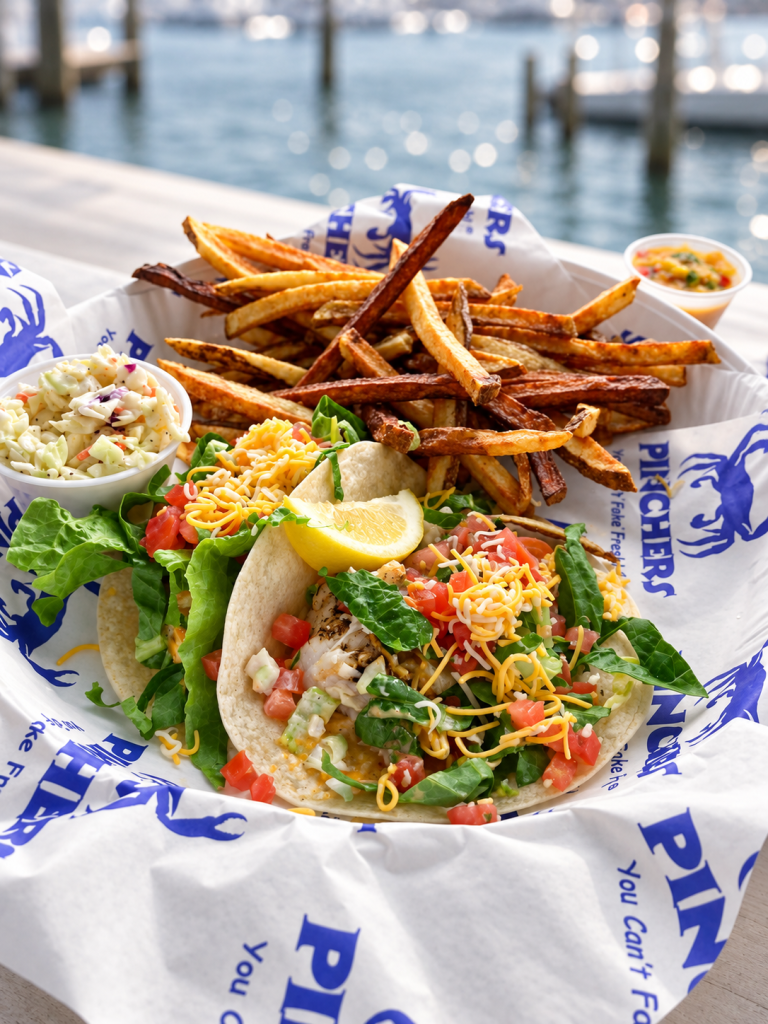
After the three‑hour drive, I checked into Hyatt House Naples/5th Avenue, dropped my bags, and wandered through the underpass to Tin City for lunch at Pinchers.
Grilled grouper tacos, fries, coleslaw, iced tea — enough food that half of lunch became dinner.
By late afternoon, thunder rolled in, so I surrendered to the weather and headed to the hotel’s Latitude 26 for happy hour. Sometimes adventure means knowing when to stop.
Docks on Fifth Marina
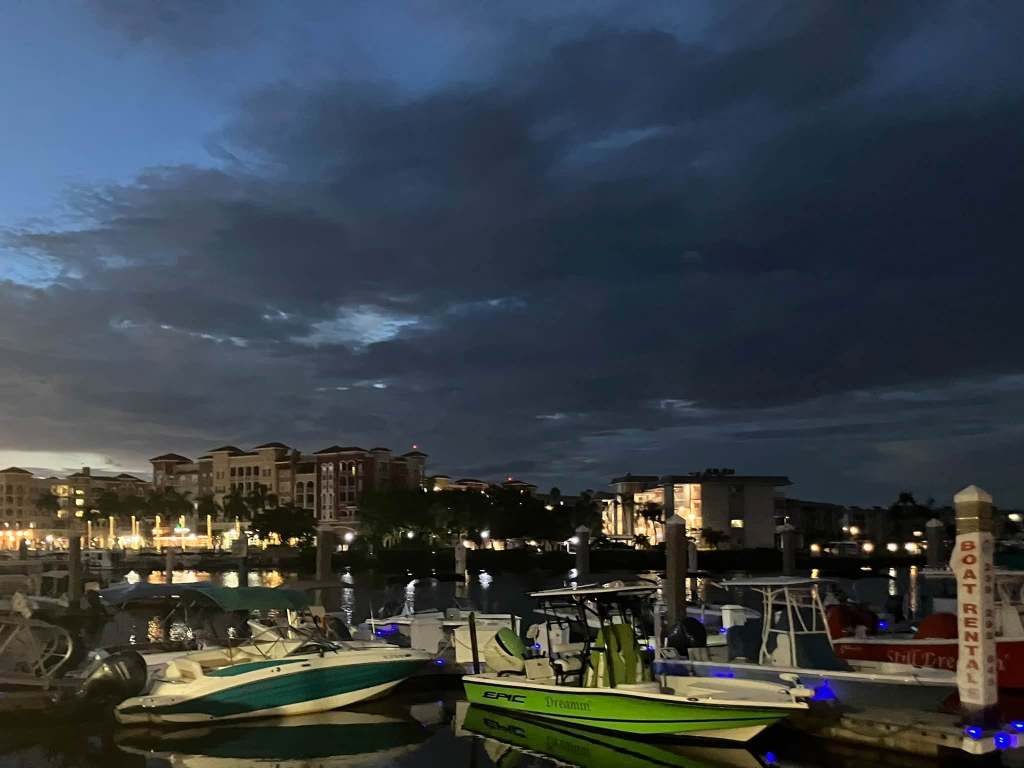
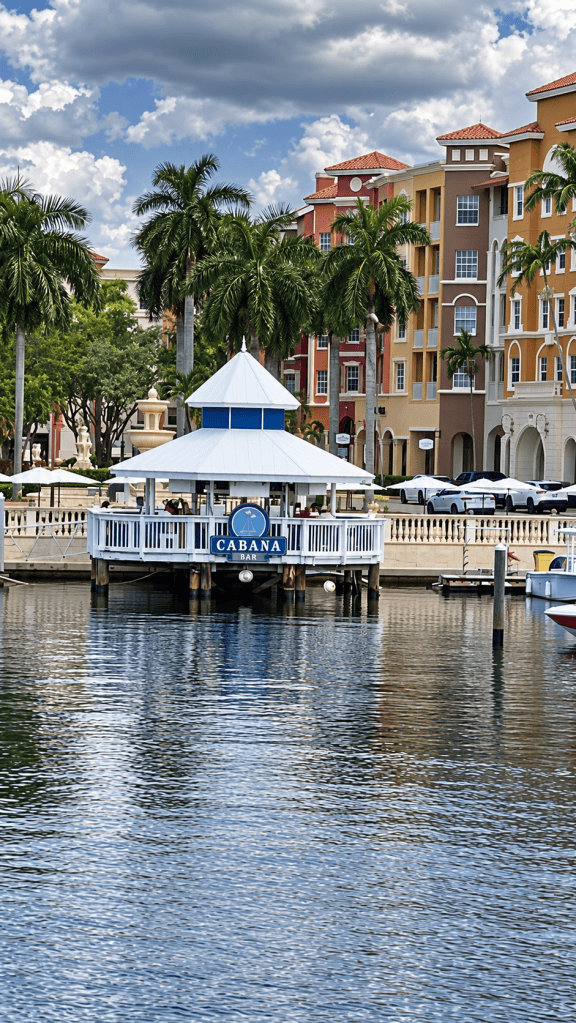
The hotel sits along the Gordon River, where palms frame a marina dotted with boats and soft reflections.
Following the deck leads to the Cabana Bar, K‑Rico Mexican Grill, and Tavern on the Bay.
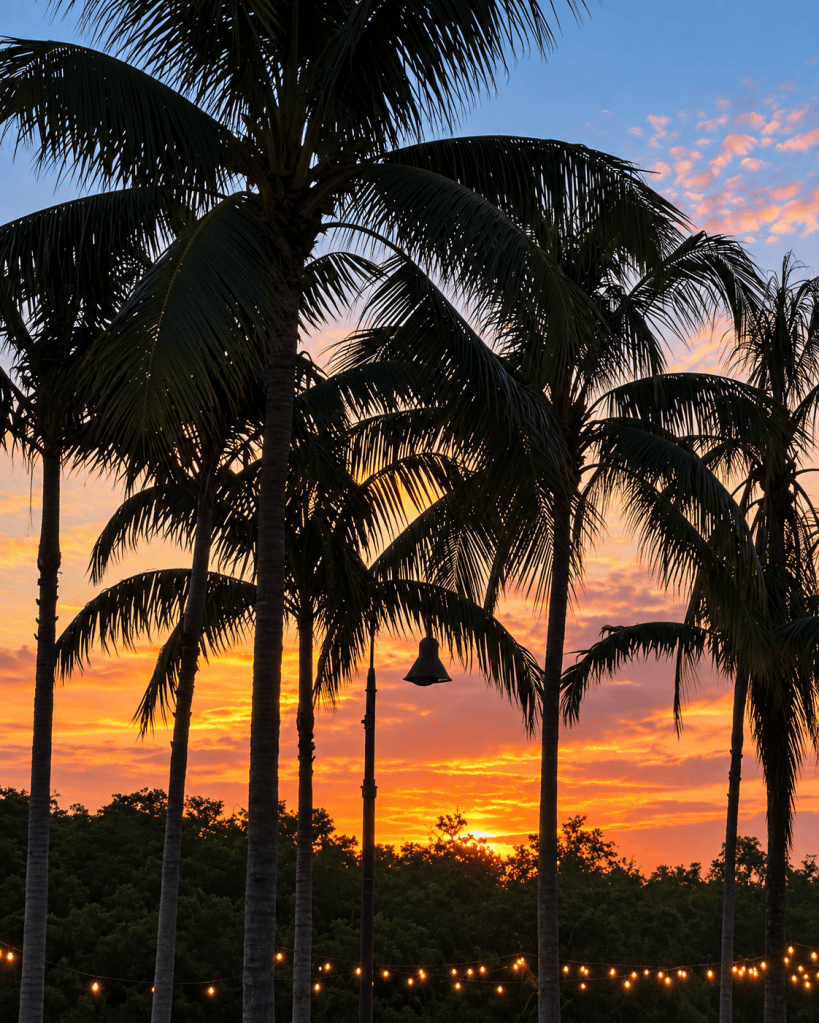
The next morning, sunrise filtered through the palms, washing the marina in gold and coral. I carried my coffee outside and watched Naples wake up.
Not a bad way to start a day.
The Parking Meter From Hell
Wednesday morning was beautiful, so I drove to Lowdermilk Park — a Naples beach I’d never visited. Finding the beach was easy. Parking was where things got interesting.
I walked over to the pay station, intending to purchase an hour for $5. I made my selections, paid, and walked away.
A few minutes later, I looked at the receipt.
$51.75.
I stared at it.
Apparently, I had not purchased an hour of beach parking. I had purchased what appeared to be an entire day of Naples beachfront real estate.
I went back to the machine and hit cancel, hoping to reverse my accidental contribution to the Naples parking fund.
The charge had already been approved.
I called the city parking line. The woman who answered was extremely pleasant as she explained they were unable to issue refunds. She suggested I dispute the charge with my credit-card company.
So that was that.
I spent a grand total of thirty-five minutes at Lowdermilk Park.
At that rate, I believe I briefly became the highest-paying beachgoer in Naples.
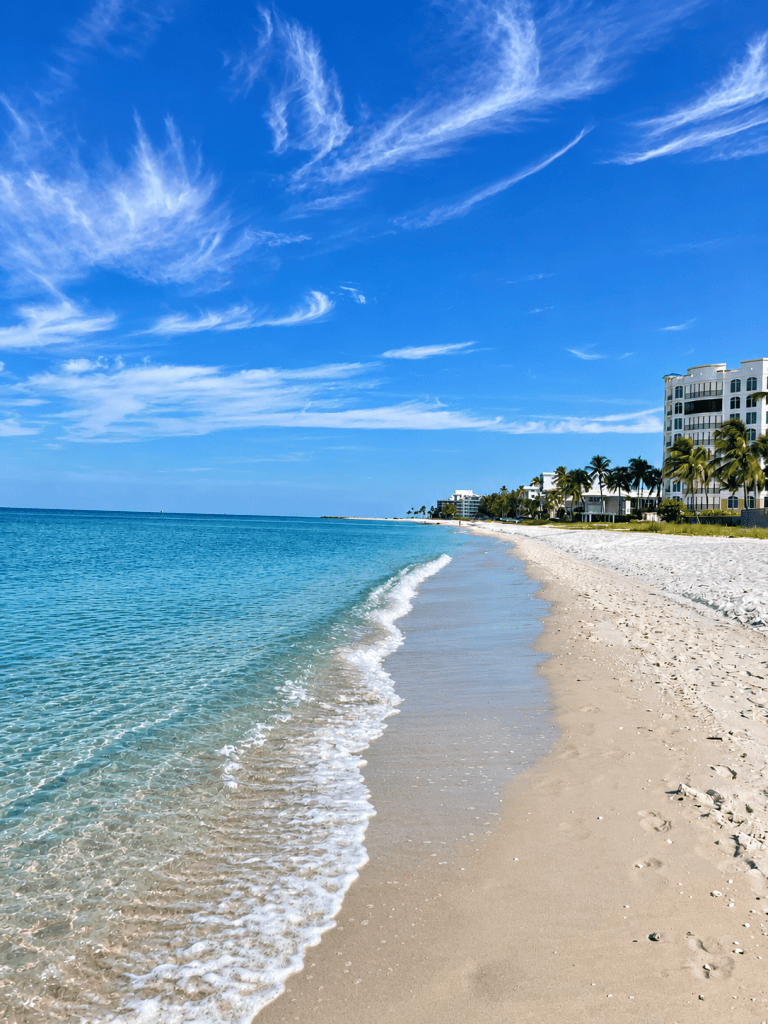
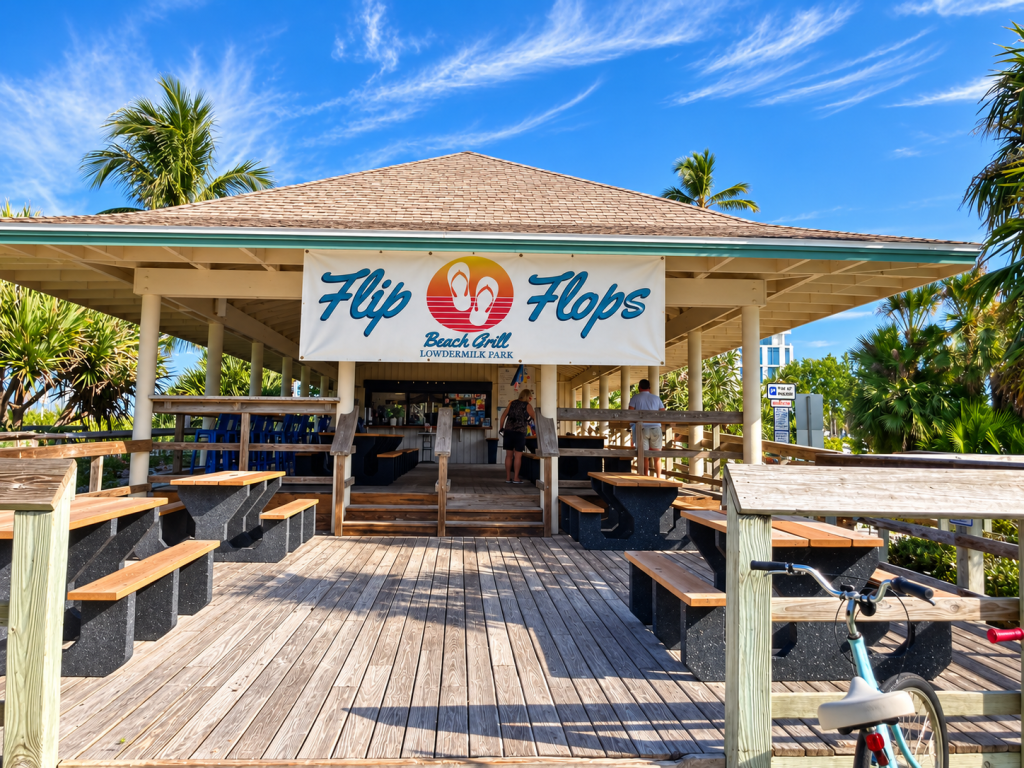
Lowdermilk itself was lovely — wide beach, paved parking, and Flip Flops, a beachfront pavilion serving breakfast, lunch, and coffee.
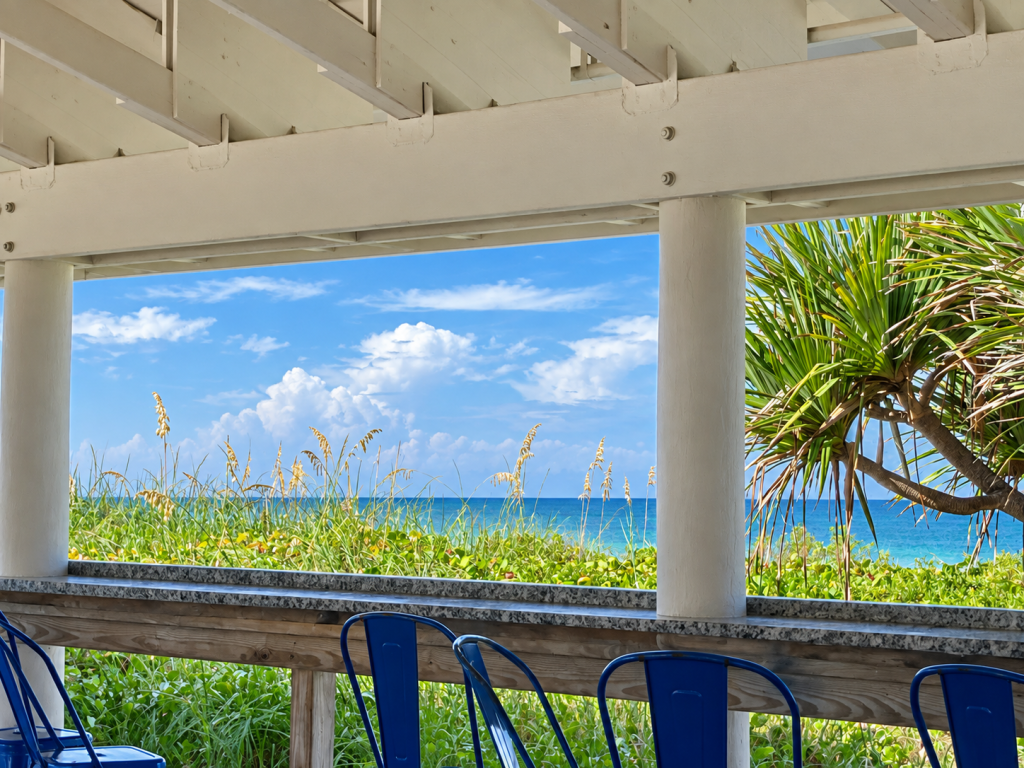
Seats along the railing overlook the Gulf.
Beautiful beach. Expensive lesson.
Remembering Naples
From there, I headed toward Fifth Avenue.
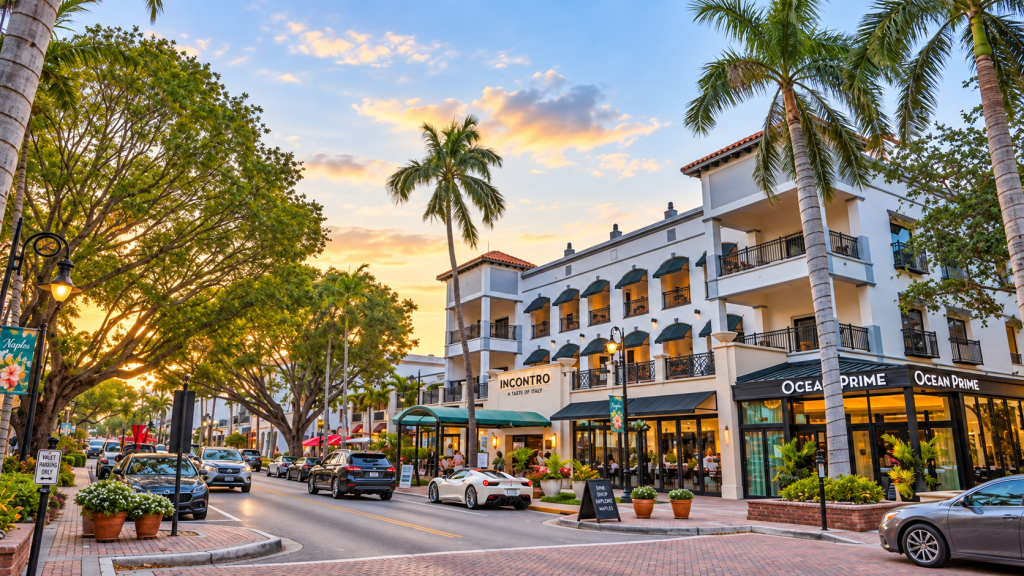
It had been four years since my last visit, and I’d forgotten how pretty downtown Naples is. Restaurants, galleries, and shops spill onto the side streets, giving the whole area that postcard quality Naples does so well.
I wandered into Art on Fifth Ave Naples, exercised remarkable financial discipline, and left without buying anything.
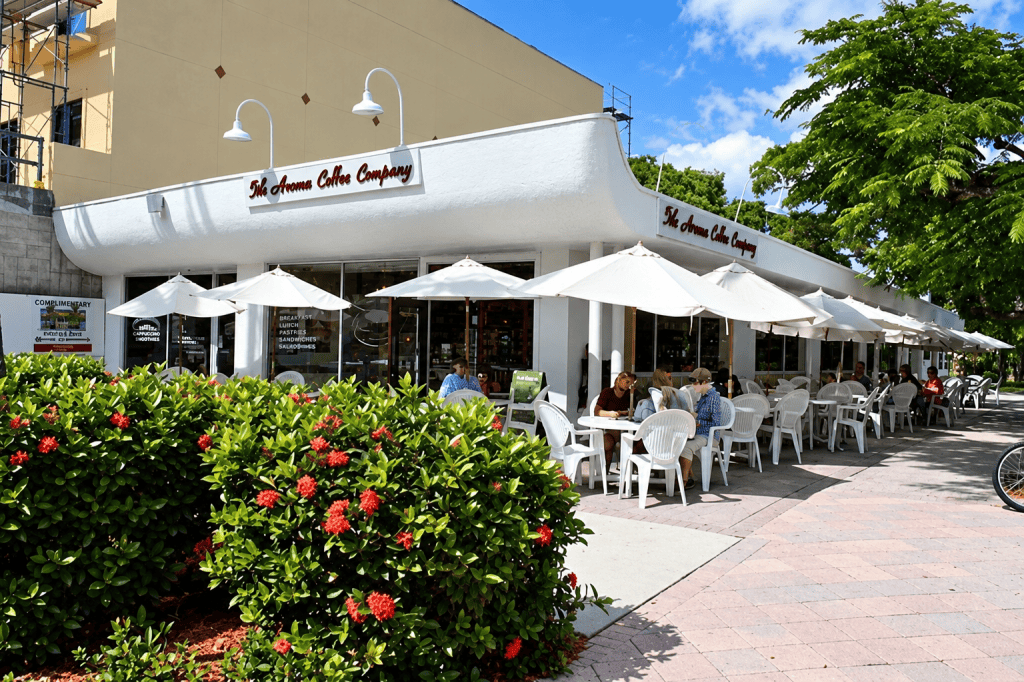
Eventually iced coffee became a priority, so I crossed over to 5th Avenue Coffee Co. & 6th Street Diner.
The iced coffee was one of the best I’ve ever had. If I lived locally, this would become a problem.
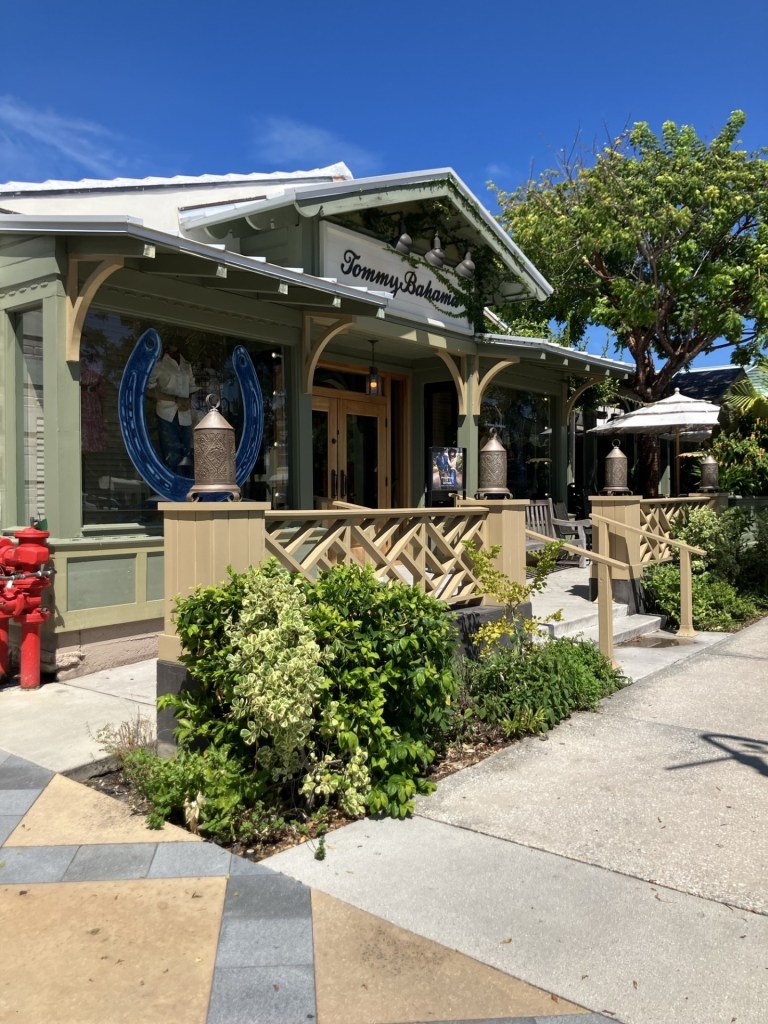
Third Street brought me to Tommy Bahama — a much larger store than my local store at Disney Springs. A sales associate proudly pointed out that this was the original location.
Then I discovered the Tommy Bahama restaurant next door. Another entry on the return‑trip list.
My relaxing little getaway was quietly becoming reconnaissance for the next one.
But Naples still had a surprise waiting.
A Grocery Store Walks Into a Nightclub
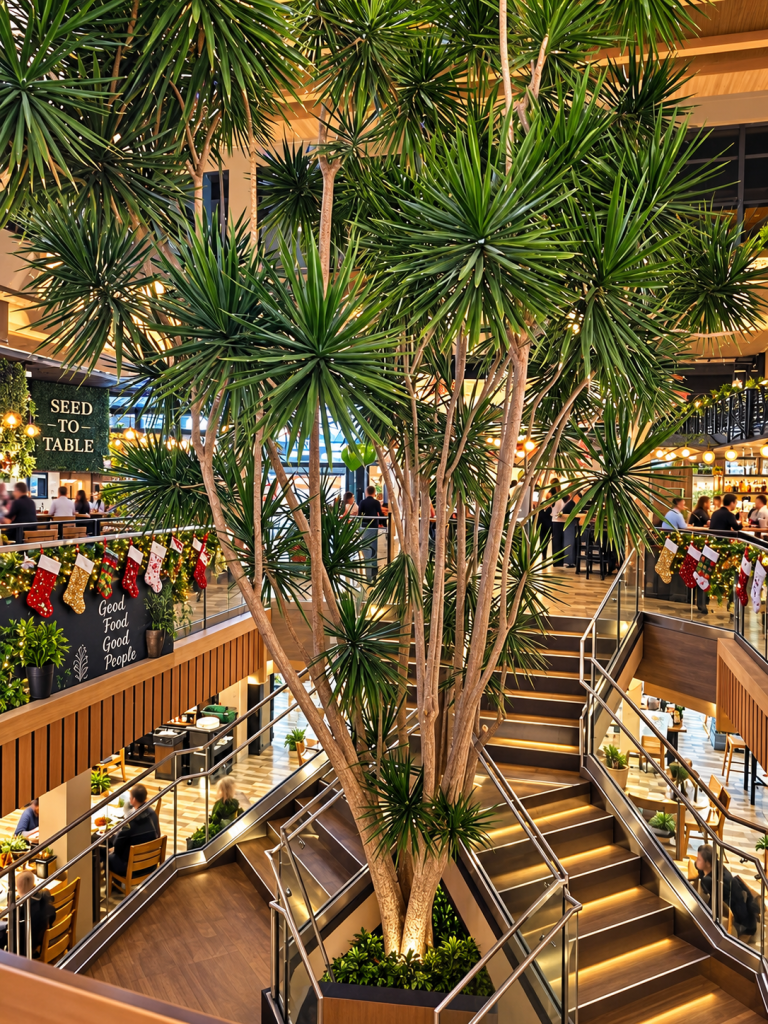
About twenty-five minutes later, I arrived at Seed to Table. I knew it was a grocery store. That description turned out to be wildly inadequate.
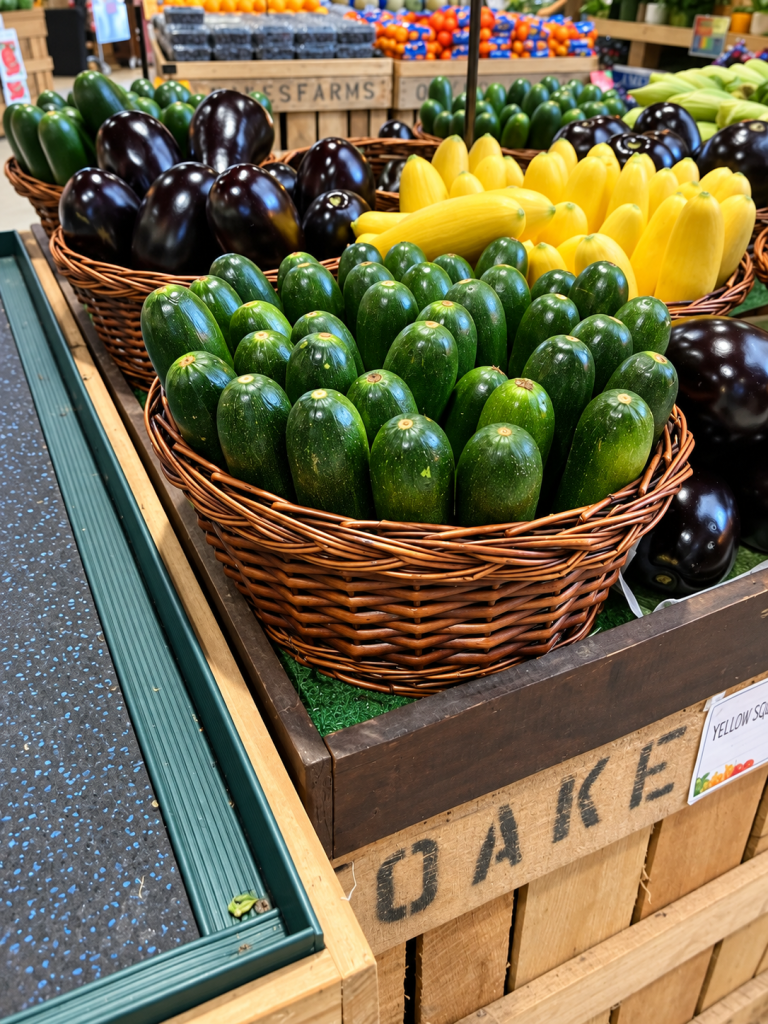
Seed to Table is part of the Oakes Farms family of businesses, with much of its produce grown on Oakes Farms acreage in Southwest Florida. That may explain the attention given to its produce displays.
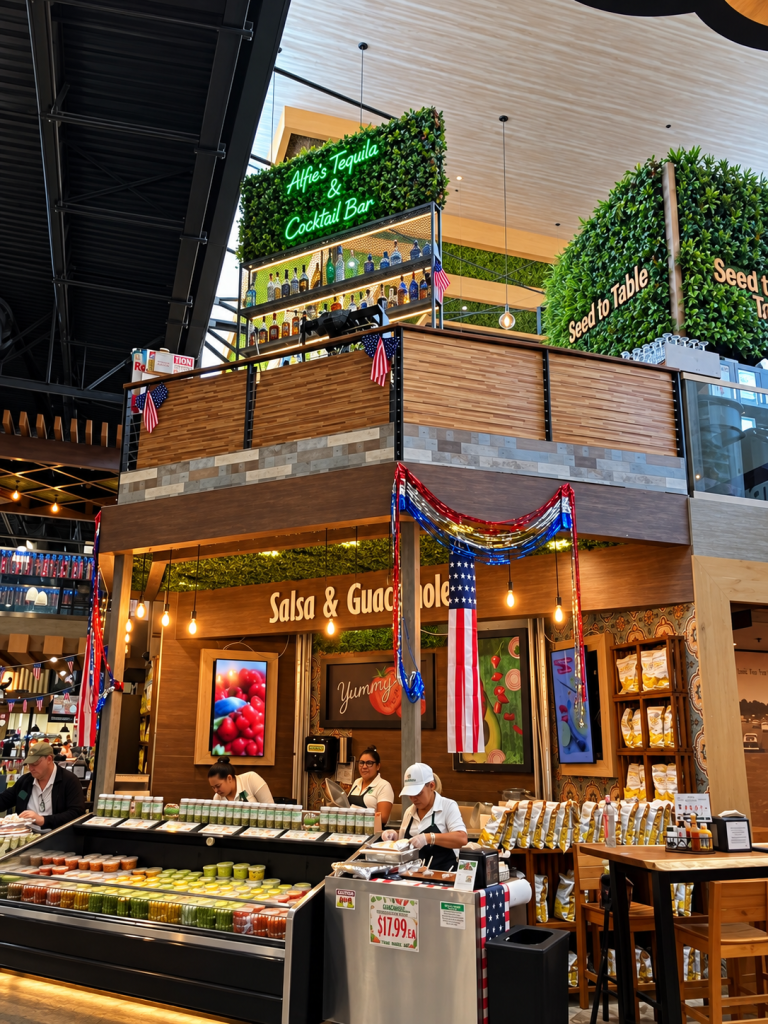
Seed to Table is enormous — food stations offering sushi, seafood, steaks, tacos, and cheesesteaks line the perimeter. Wine and cheese areas. Bars. Restaurants.
There is an upstairs dining level with a giant indoor tree rising through the center.
A glowing neon sign announces Alfie’s Tequila & Cocktail Bar.
And, apparently, you can grocery shop while sipping wine. Suddenly Publix seemed terribly underdressed.
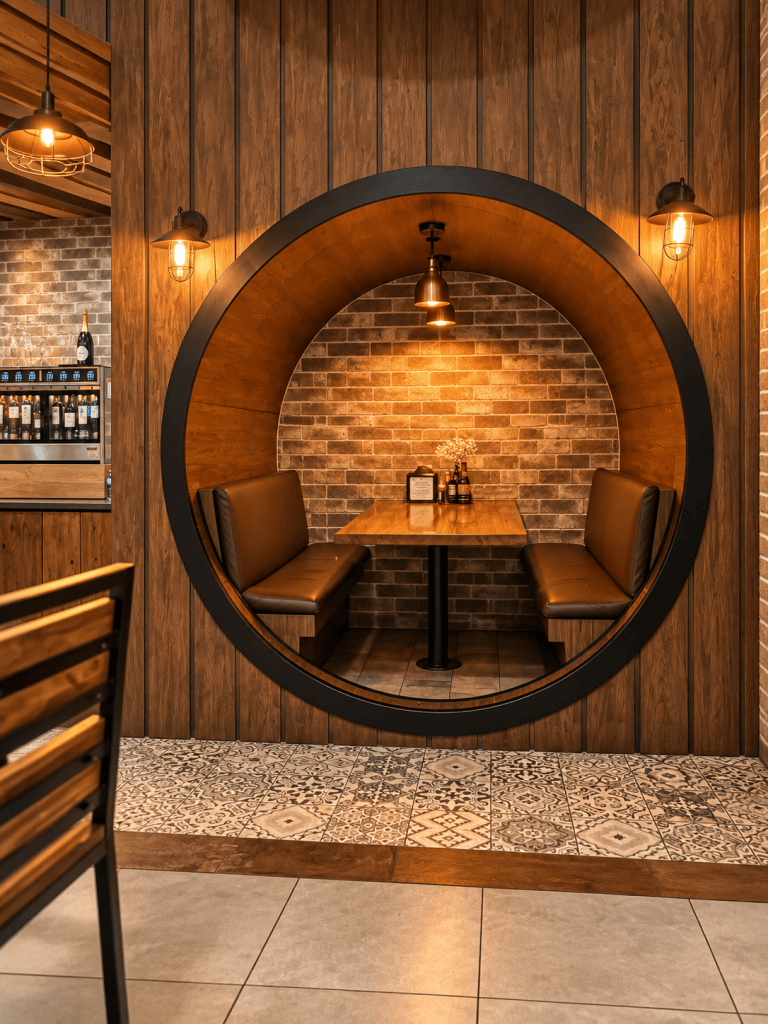
Dining tables sit throughout the main level, including one booth tucked inside what looks like an enormous wine barrel.
I walked upstairs, found a high‑top table, and ordered the Southwest Chicken Salad. The portion looked designed for a small committee.
Then I noticed a sign on the stairwell.
Girls Night Out. 8–10 p.m.
At a grocery store.
Obviously, further investigation was required.
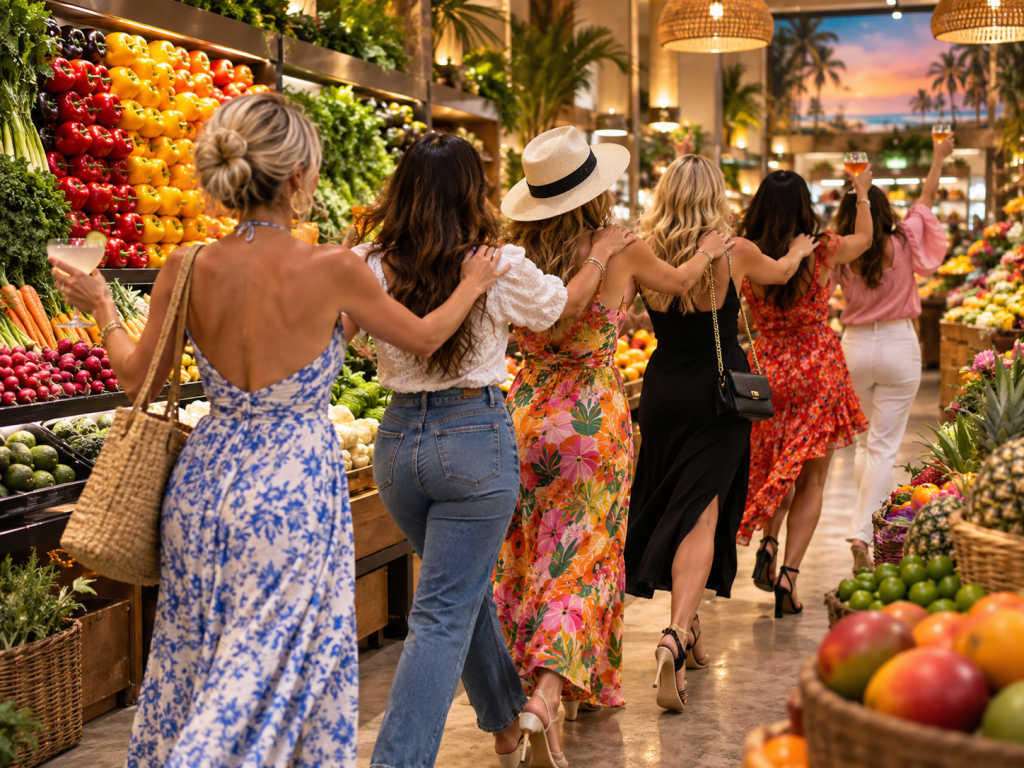
Girls’ Night Out – Naples Style
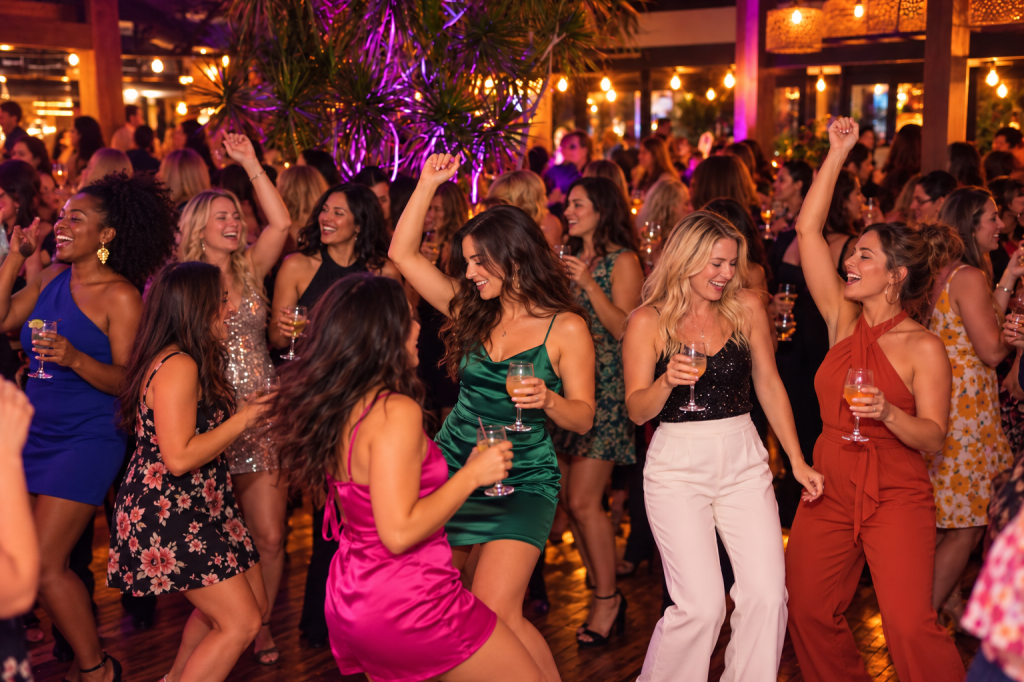
By eight o’clock, DJ Messina was playing dance music.
The regular tables and chairs near the upstairs railing had been moved aside to create more room.
Women could walk up to the bar and order free drinks.
The main bar was sectioned off and lined with male patrons.
Downstairs, people were dining at tables. Others were pushing carts through grocery aisles.
Meanwhile, upstairs women were dancing to music from the ‘80s and ‘90s.
Every so often I looked over the railing and smiled. A few shoppers danced their way through the aisles. At one point, a conga line wound past the produce displays.
The lettuce watched. The cucumbers judged. The eggplants posed like they were waiting for a casting call.
It was impossible not to appreciate the absurdity of it.
Where else can you order a steak dinner, buy groceries, sip a cocktail and hit the dance floor without ever leaving the building?
Even the produce seemed ready for a close‑up — cucumbers arranged neatly in wooden baskets, eggplants and peppers styled rather than stocked.
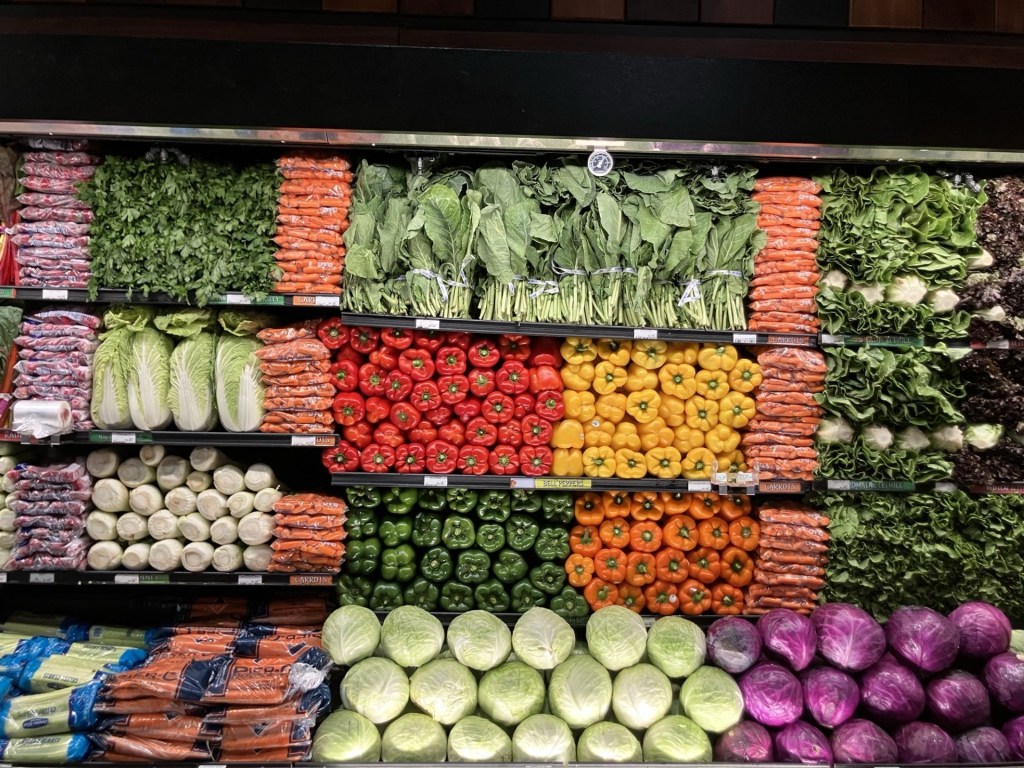
And one refrigerated wall arranged in blocks of color like someone hired an art director for the vegetables.
Some stores stock produce. Seed to Table stages it.
The energy kept building, but after about an hour I decided to head back toward downtown Naples before the next round of storms. On the drive, I passed another Oakes Farms market and made yet another mental note for another day.
Naples now requires a sequel.
Final Thoughts
My final morning was quiet. After an early breakfast, I took a walk around the marina and decided not to cram anything else into the trip.
The three-hour drive home was still ahead of me.
There had been no major travel drama.
Sometimes a trip doesn’t need to become a grand story.
There’s a moment on every horse girl’s journey when the world reminds her that she’s still wired for adventure—even if the “wild” isn’t on horseback.
As we get older and that final horse becomes a memory, many of us opt to leave the barn empty. Owning a horse is a commitment measured in years, early mornings, veterinary bills—and a piece of your heart you already know will one day break.
But aging horse girls don’t give up. We ride rentals.
We find horses on beaches, mountain trails, islands, and ranches far from home. None of them is our horse, and each one feels different beneath us.
Some are steady. Some are opinionated. Each one asks us to listen, adapt, and discover something about the rider we’ve become.
They don’t replace the horses we loved. Each one adds a new name, a new story, and another set of hoofprints to the herd we carry with us.
Sometimes the adventure doesn’t involve a horse. But the lessons from the herd stay with us long after we’ve closed the barn door.
Harnessed for Adventure
Every good trail ride begins before anyone gets in the saddle.
You check the tack, secure anything that might come loose, listen to the person who knows the trail, and make certain everyone is properly equipped for what lies ahead.
The Wild Africa Trek began much the same way.
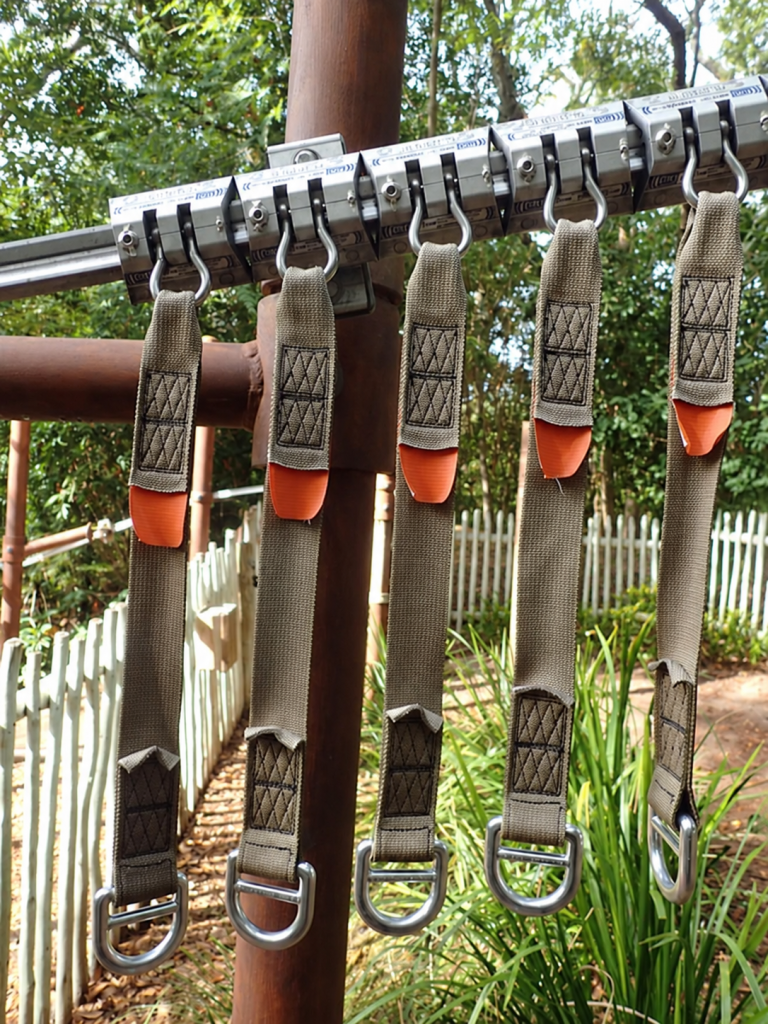
We were fitted with safety vests and harnesses, and everything we carried had to be secured. Whenever the trail brought us near an unsecured edge or onto one of the bridges, we clipped into a safety line.
That reassuring little click said: “You’re safe…but don’t lean too far.”
I’m adventurous. I am not careless.
Horse girls know the difference—and they rely on dependable equipment.
Into the Woods
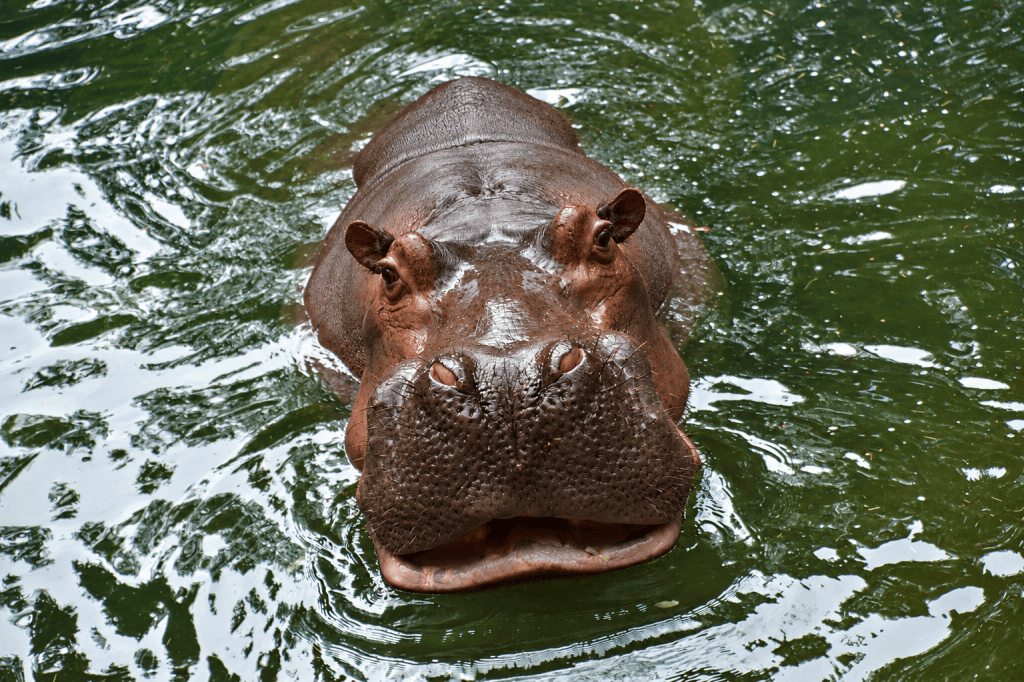
We started with a short, wooded hike, the kind that feels deceptively calm until you realize you’re walking toward a hippo watering hole.
Almost immediately, the experience felt different from an ordinary visit to Disney World’s Animal Kingdom. We weren’t watching the landscape pass from a vehicle. We were walking through it, listening to the guides and slowing down long enough to observe the animals rather than merely identify them.
There is something humbling about standing near a hippo.
They don’t need to perform.
They simply occupy the landscape with the quiet confidence of an animal that knows nobody is going to ask it to step aside.
At the Watering Hole
At the elevated overlook, we clipped our harnesses onto the safety system before approaching the edge.
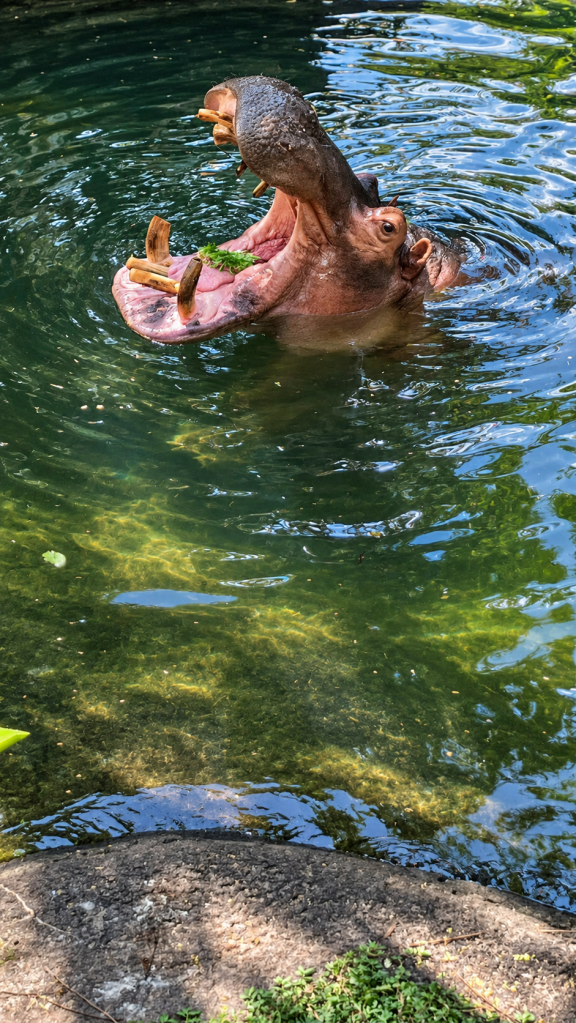
Being tethered allowed us to lean out far enough for an unobstructed view while still feeling secure. Suspended above the water, we watched these massive creatures move with surprising grace.
It was the kind of view you can’t get from a safari truck—the kind that makes you forget you’re not somewhere deep in Kenya.
The hippos looked prehistoric and unbothered. This is their home, and we were visitors on their terms.
One opened its mouth wide enough to provide a complete dental tour.
Wild animals have personalities. Some are dignified. Some are curious.
The hippo definitely had opinions.
Speaking Equus in the Wild
Years around horses teaches you that animals are always communicating.
An ear turns. A head lifts. Weight shifts. The smallest movement can tell you whether an animal is curious, relaxed, wary—or preparing to leave the conversation altogether.
Horses taught me to listen with my eyes.
As we approached the viewing area, I quietly wondered whether any of the other animals might recognize some version of that same language.
Direct eye contact, squared shoulders, and forward energy can resemble a predator’s approach. So instead, I lowered my eyes, softened my posture, turned one shoulder, and kept my hands closed and quiet—reducing the pressure and leaving the invitation open.
The first experiment involved a hippo.
From the tethered viewing area, I changed my posture and waited.
The hippo eventually walked over and stopped directly beneath where I was standing.
Perhaps it was coincidence. Perhaps it expected a feeding.
Either way, it created an extraordinary encounter—and a wonderful photograph.
The Floating Bridge
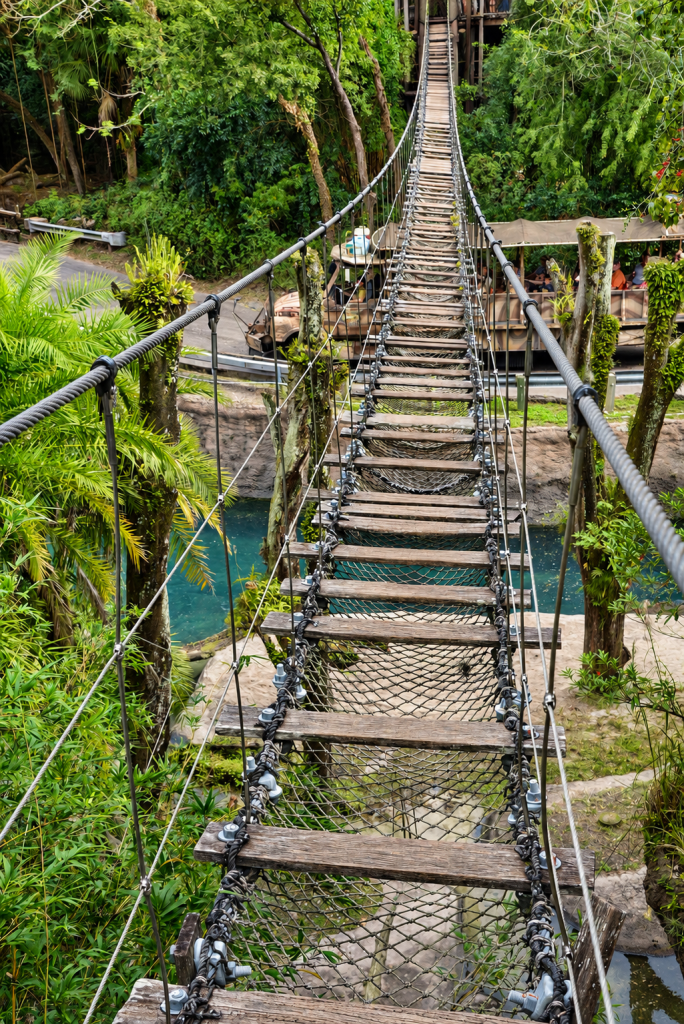
From a distance, the floating bridge looked scenic.
From the first wooden plank, it looked considerably more adventurous.
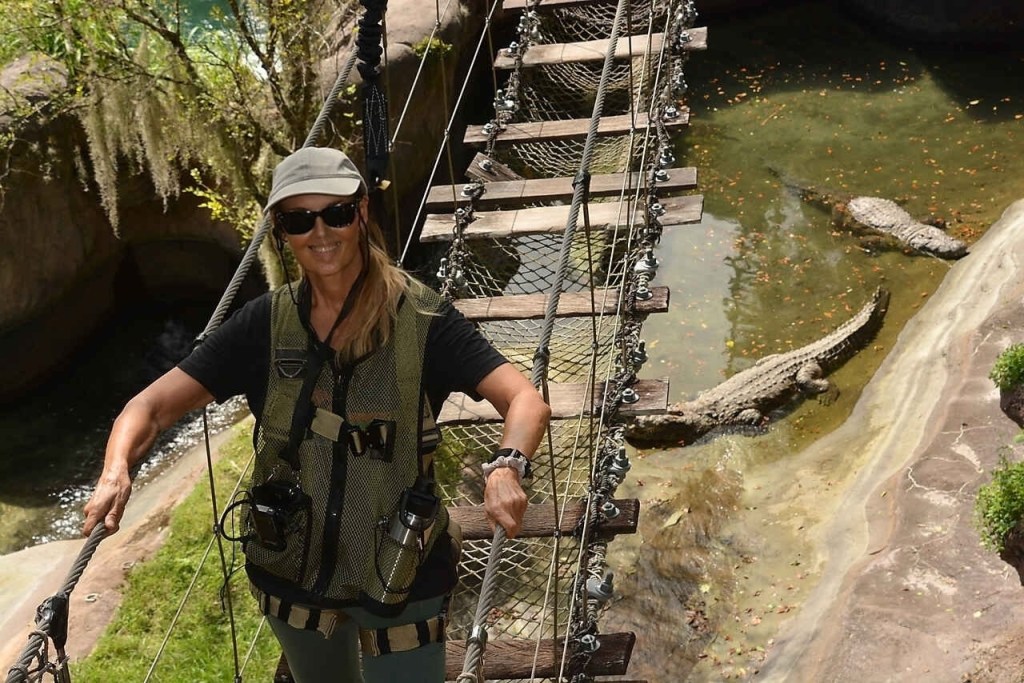
One by one, we crossed, clipped securely to an overhead safety cable and suspended over the gorge as though we were auditioning for a National Geographic special.
The bridge swayed with every movement. The open spaces between the planks provided excellent views of the crocodiles below.
A floating bridge is not entirely unlike riding an unfamiliar horse. The footing shifts. You become very aware of your balance. And staring anxiously at the ground beneath you rarely improves the situation.
So I held the ropes, trusted the harness, and continued forward one plank at a time.
Horse girls understand this negotiation: Respect what is beneath you.
Trust the equipment. Keep your balance. Don’t create unnecessary drama.
The bridge swayed. I kept moving.
It was exhilarating, surreal—and oddly peaceful.
Beyond the Usual Safari Route
The back-lane safari drive came next.
We rolled through areas the standard vehicles never touch, slipping behind the scenes and into quiet corners where the animals wandered without an audience.
The guides shared information while the animals grazed, rested, and occasionally moved close enough to inspect the intruders.
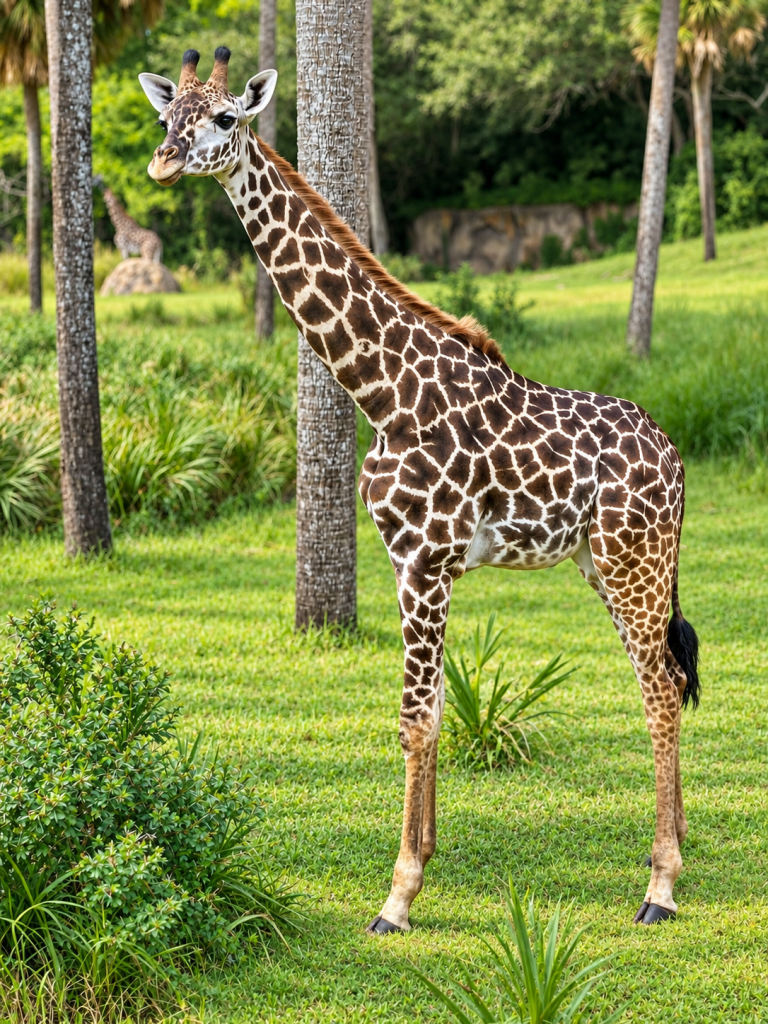
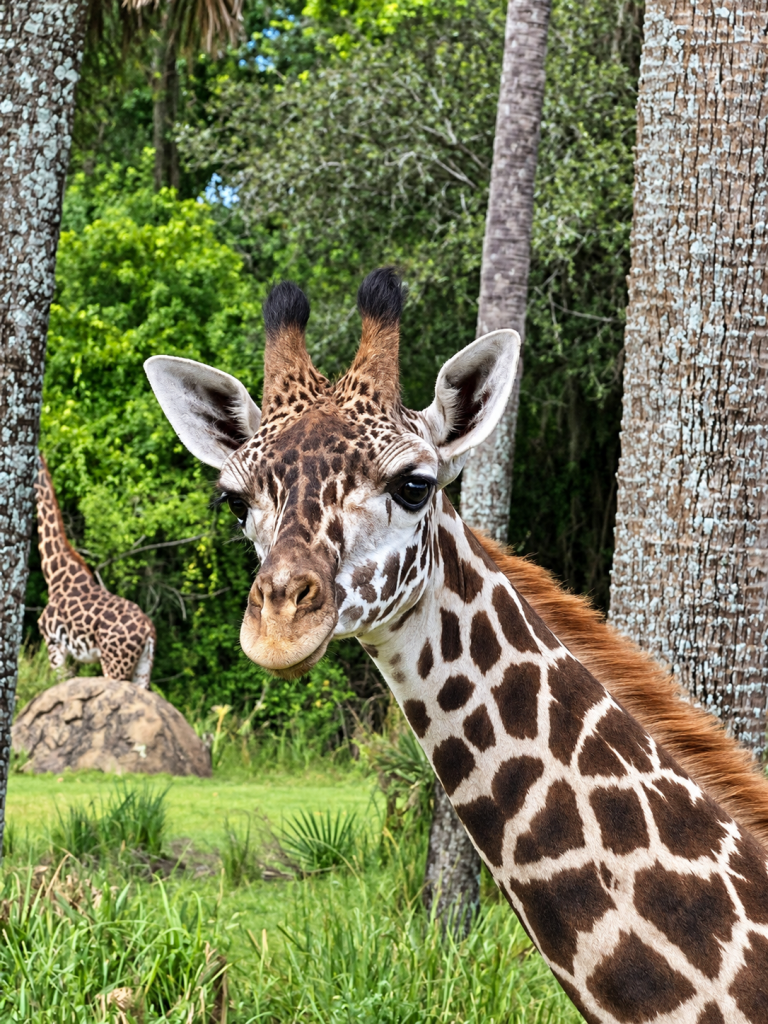
Several giraffes were gathered near a tree as our vehicle approached. I was seated beside the open window, so I quietly tried my experiment again.
I removed my sunglasses, lowered my eyes, and tipped one shoulder toward a young giraffe.
It left the others and walked directly toward the vehicle without hesitation. It stopped only a few feet away and stared straight into my camera lens.
Again, it may have been entirely coincidental. Wild animals make their own decisions, and I would never claim to speak fluent giraffe—or conversational hippo.
But horse girls recognize the moment when an animal chooses to close the distance.
For a few seconds, the savanna grew very quiet. The language of Equus seemed far more universal in the moment.
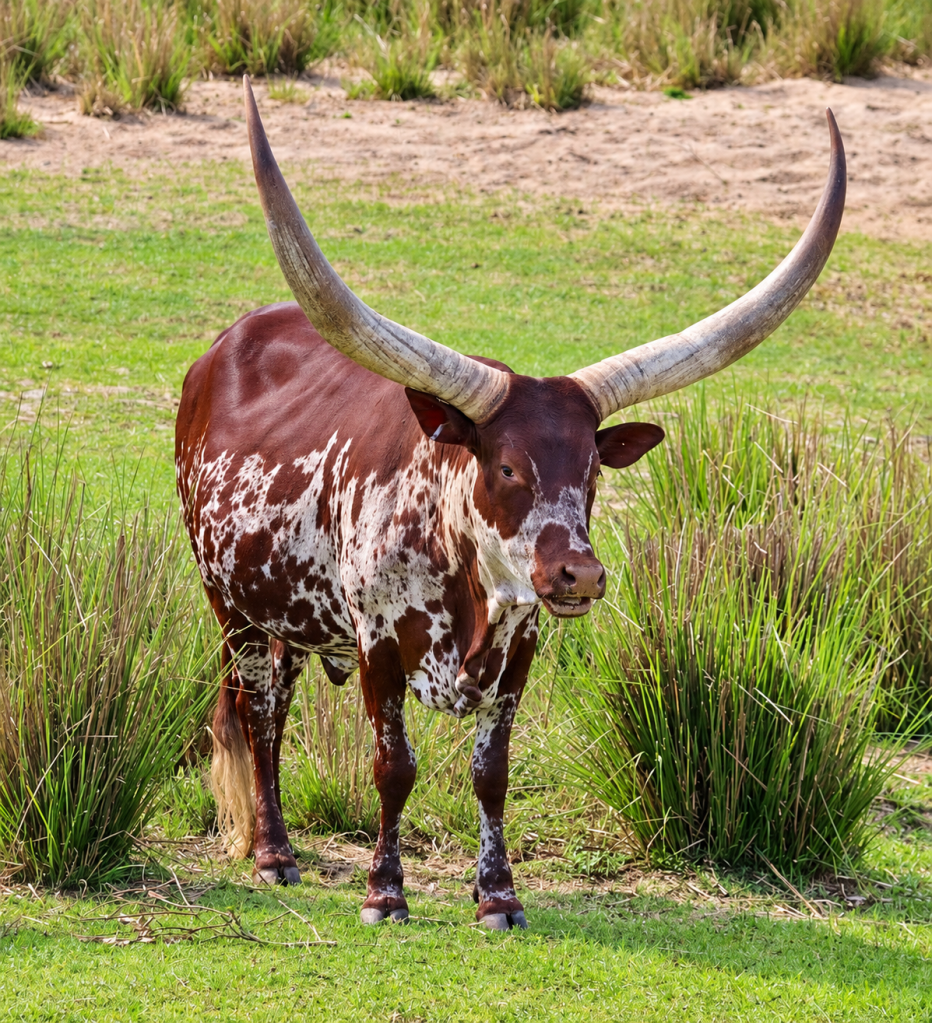
The Ankole cattle were equally impressive. With enormous sweeping horns and an air of complete serenity, they looked like living sculptures placed deliberately against the landscape.
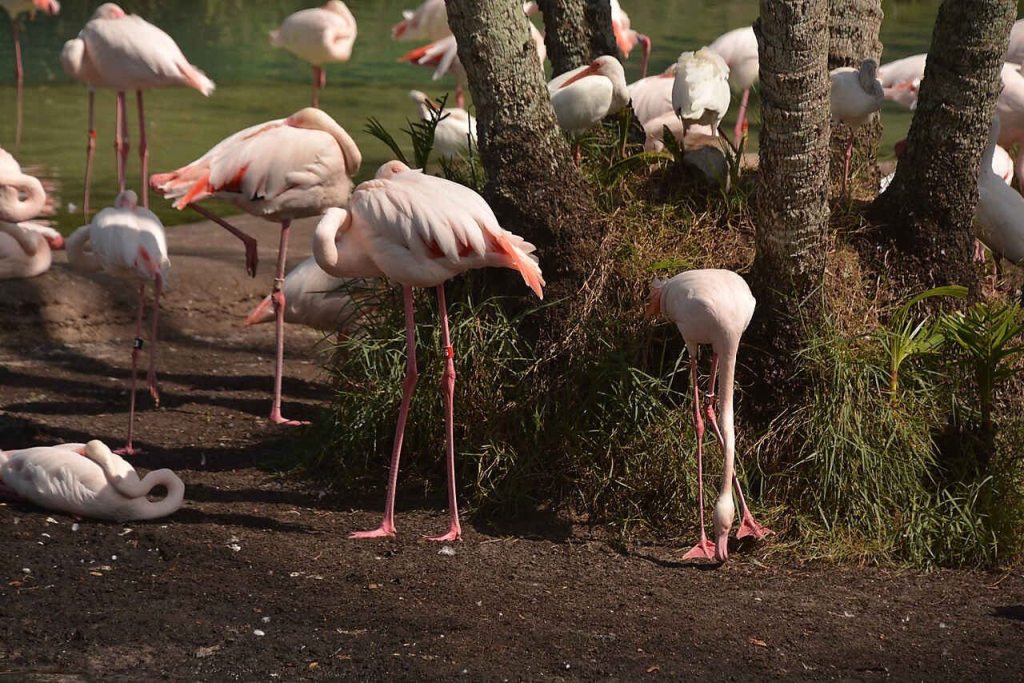
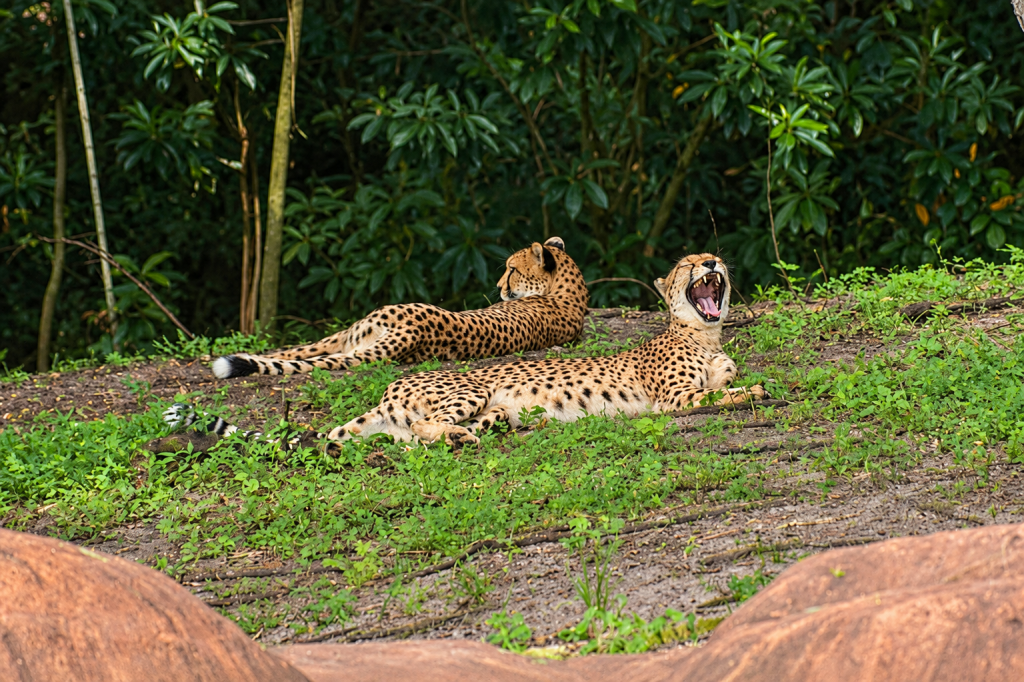
Giraffes strolled like runway models. Elephants threw shade. A crocodile stretched in the sun, and a flamboyance of flamingos posed at the water’s edge.. the savanna quietly spoke. We listened.
Lunch on the Savanna
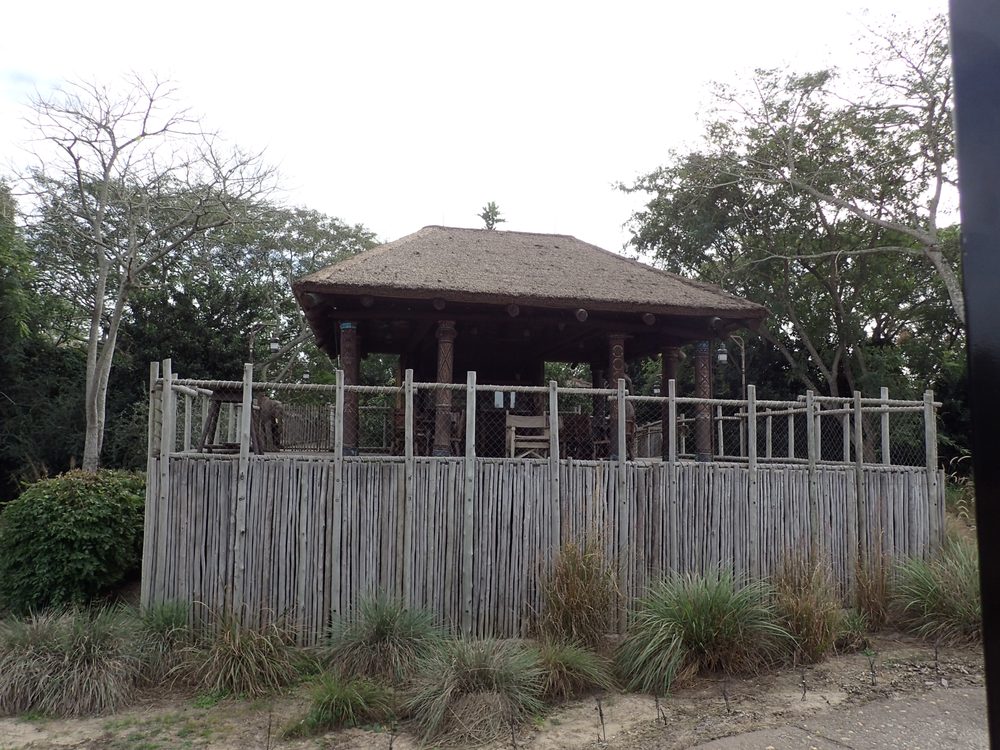
Lunch was held at a custom-built safari camp located at the highest point in the savanna.
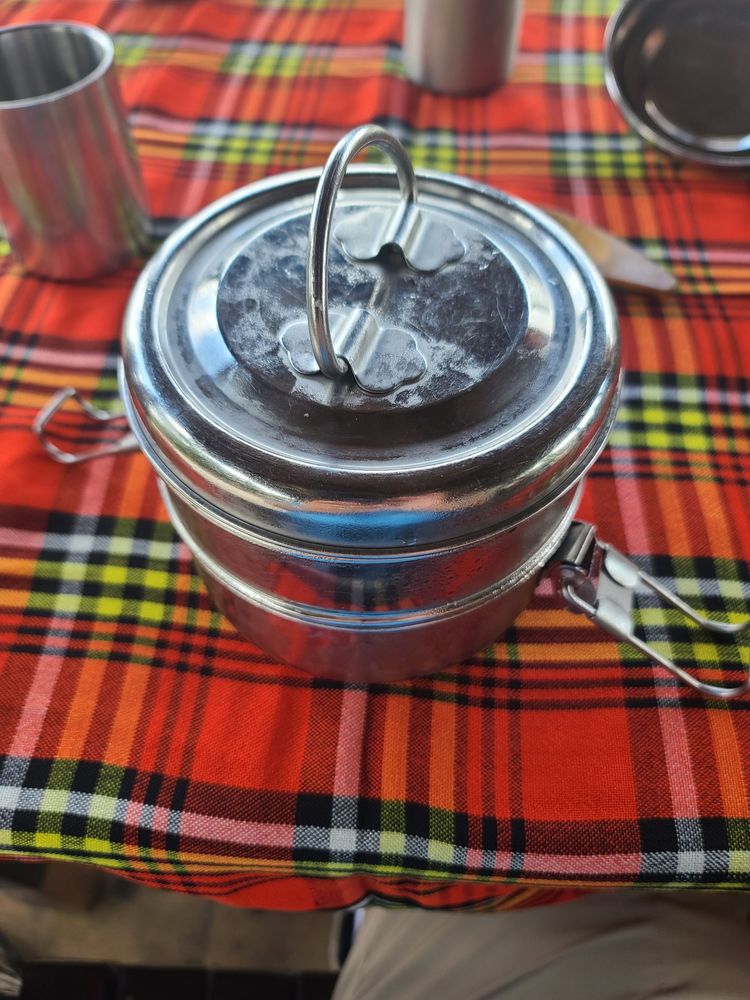
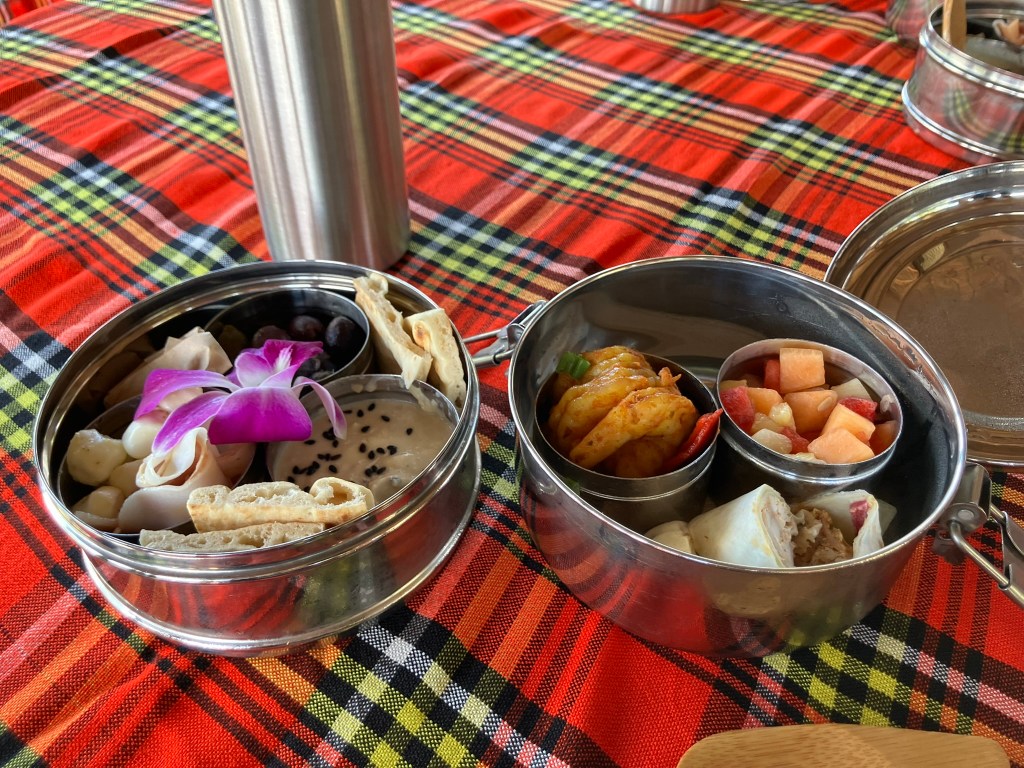
Lunch arrived in stacked metal tiffin containers. Opening each layer felt like discovering another course: colorful fruit, shrimp, a chicken wrap, spreads, vegetables, and several small bites that were fresh, bright, unusual, and delicious.
It was part picnic, part expedition ration, part culinary mystery.
This was not a sandwich pulled from a backpack while sitting on a convenient rock. It was a carefully prepared catered lunch served with the savanna stretching beyond us and animals wandering in the distance.
The Herd Keeps Growing
There wasn’t a horse on the Wild Africa Trek, but whenever I’m among animals, the horse girl in me inevitably surfaces.
She was there as I checked the equipment, watched the animals, trusted my footing, crossed the bridge, and quietly invited two very different animals to close the distance.
The experience felt much like navigating an unfamiliar trail on horseback. You trust the horse beneath you to find the footing, rely on the instincts experience has sharpened, and remain open to whatever waits around the next bend.
This time, I trusted the harness, the guides, and my own two feet.
What made the trek memorable wasn’t one dramatic moment, but the progression: leaving the familiar path, clipping onto that first safety line, meeting the animals on their terms.
The photographs captured the animals.
What they don’t capture is the quiet exhale.
For a few hours, the world slowed down, the savanna opened up, and the horse girl felt right at home among creatures who move with power and purpose.
Perhaps that’s what horse girls carry with us long after we close the barn door: curiosity, resilience, respect for animals—and the willingness to follow the trail when it wanders somewhere unexpected.
The horses we meet join the ones who carried us before. Other animals widen the circle. The destinations change.
Somehow, the herd keeps growing.
Adventure doesn’t always require a saddle.
Sometimes it just requires a harness, a swaying bridge, and a savanna with attitude.
if the wine were stored in a tack trunk, covered in shavings, and smelled faintly of liniment and fly spray.
We’re built differently.
We can spot a lame horse from 300 yards away—but walk straight into the pothole in front of us.
We can recite a horse’s full medical history, lineage, favorite treat, enemies, and emotional triggers…
but lose our sunglasses while they’re sitting on top of our head.
We can back a trailer into a space the size of a shoebox in the dark, while being judged by three strangers and a horse—
but somehow the airport pickup line is the more dangerous sport.
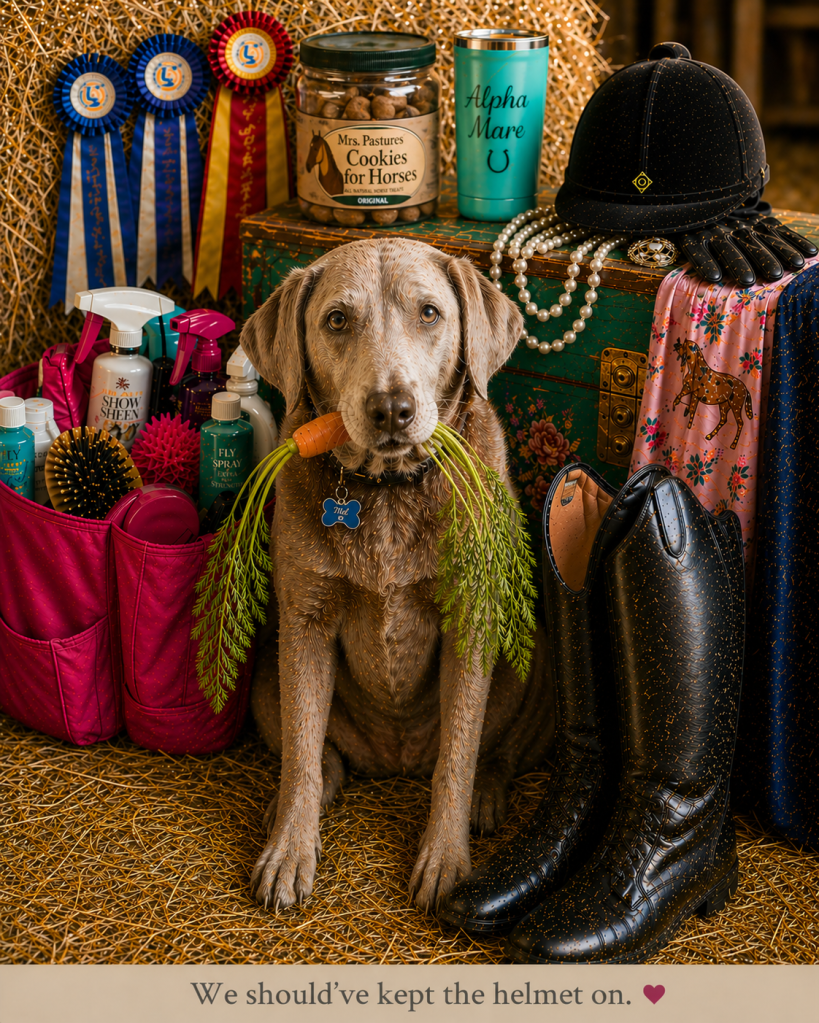
We dress like we might need to ride at any moment.
Even if we’re going to Publix. Even if we haven’t touched a horse in a decade.
Boots? Always. Hair tie? Mandatory. That faint smell of fly spray?
Not a phase. A lifestyle choice.
We don’t need directions.
We navigate using instinct, landmarks that no longer exist, and directions based on a horse trail we rode once in 1998.
We can confidently go in the wrong direction— and still somehow arrive first.
Don’t question it.
We have two default settings.
Elegant equestrian goddess.
Or:
Looks like she lost a bar fight with a hay bale.
There is no third option.
We don’t scare easily.
We’ve handled 1,200-pound animals having full emotional breakdowns.
We’ve ridden through spooks, bolts, bucks, and the sudden realization that the thing in the corner is, in fact, a leaf.
So no, that hostile email is not intimidating.
And yes, we did read the tone.
Yes… we still buy the boots.
Even if we don’t ride anymore.
Even if the closest we get to a barn some days is scrolling through old photographs and remembering the horses who carried us through different chapters of our lives.
Because the boots remind us of the girl who trusted her instincts and got back on when she fell.
Life has a way of bucking sideways.
Horse girls learn early that balance isn’t about perfection—it’s about staying with the ride.
I spent four days aboard Margaritaville at Sea Paradise, sailing to Freeport and Nassau in the Bahamas.
This was a girlfriends’ getaway with my friend Bernadette to help her ease into solo travel.
Despite having cabins next to each other, we had a surprisingly difficult time finding one another. We became two ships occasionally passing in the night.
Bernadette had opted against onboard Wi-Fi so coordinating meant relying on chance encounters around the ship.
Every so often our paths would cross. We would sit down, compare adventures, laugh and wander off again.
Complete strangers seemed to have no difficulty locating me.
And that became the unexpected lesson of this cruise.
Solo Is Wonderful. Vulnerable Is Different.
I love solo travel.
There is something wonderfully liberating about deciding when to eat, where to go, what to see and when you’ve had enough excitement for the day and want to disappear with a book.
But solo travel works beautifully until something doesn’t.
A lot of people begin traveling alone after years—sometimes decades—of traveling with a spouse or partner. Suddenly, the person who always sat beside you isn’t there.
You are navigating airports, hotels, cruise ships, restaurants and unfamiliar cities entirely on your own.
Most of the time, that is empowering. But being alone can also make you more visible.
This was a particularly lightly booked cruise. On a full sailing, a woman sitting alone can disappear into the crowd.
On this cruise, there were empty chairs everywhere. A solo woman sitting by herself in a lounge was like a lighthouse beacon visible from space.
Meeting people while traveling is one of the best parts of traveling alone.
And ladies, if you’re interested in a vacation romance or one-night hookup, go for it. No judgment here.
The important thing is that everyone gets to decide what they are comfortable with—and everyone else respects the answer.
Because travel can create a subtle illusion:
Companionship begins to feel like familiarity. Familiarity begins to feel like trust. And trust should never be issued on an expedited basis.
Especially when alcohol joins the itinerary.
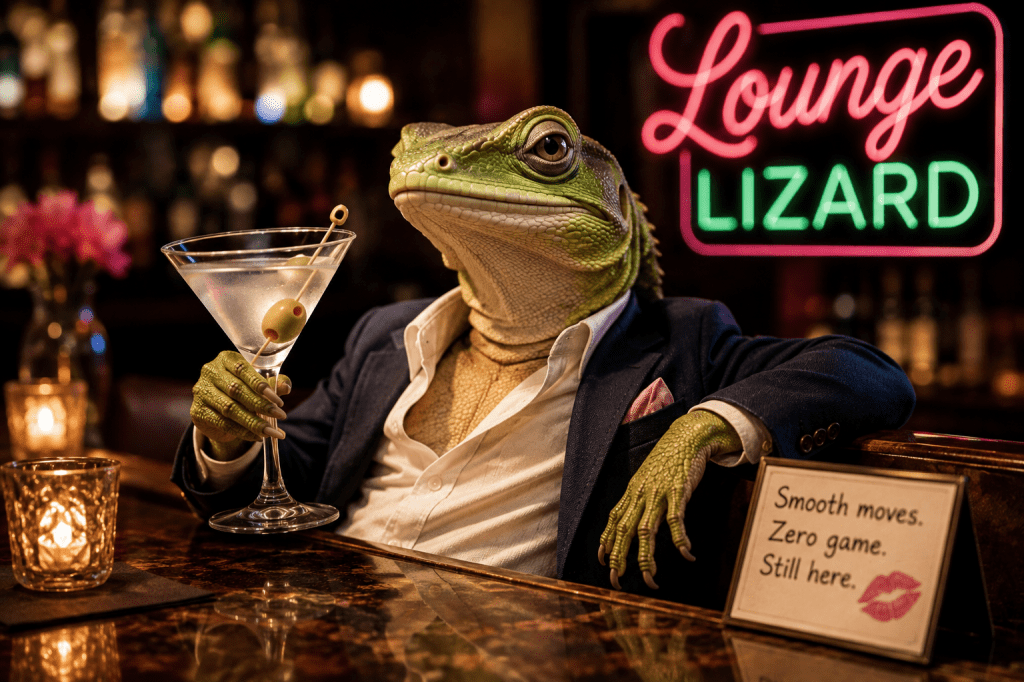
Enter the Floating Lounge Lizard
It began innocently enough on the first evening.
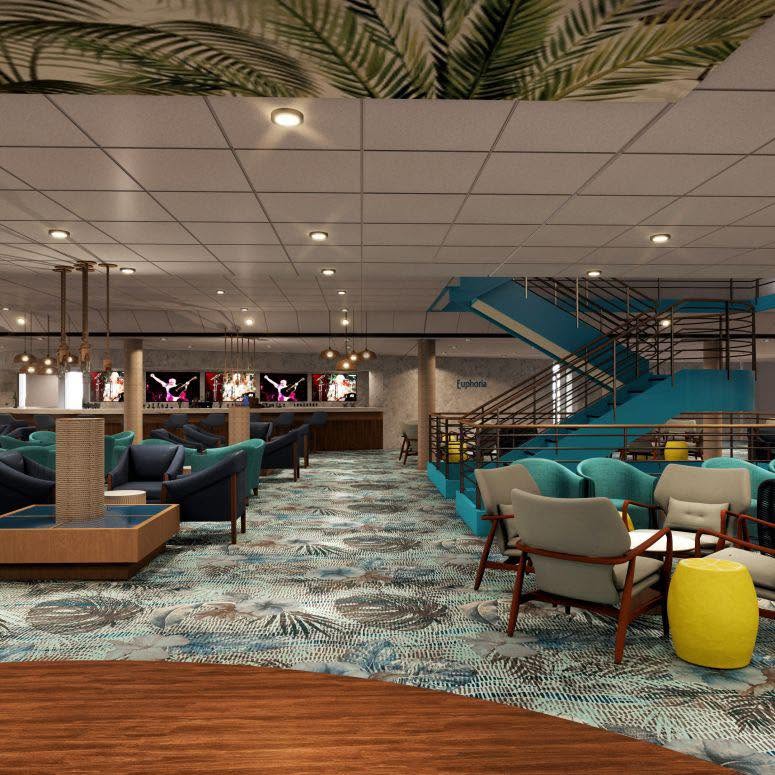
I was sitting alone in Euphoria Lounge listening to the band when a man approached and asked whether he could have the empty chair beside me.
Cruise lounges are usually crowded. People share tables all the time. Without even looking around, I automatically said yes.
Mistake number one.
I looked over as he sat down.
He resembled Drew Carey, the comedian. I never learned his name, so we’ll call him Drew.
Within minutes, Drew was consuming bourbon at an impressive rate.
Then came the chatty compliments. More bourbon. And a brief departure to his stateroom before karaoke.
When he returned, I could smell the mouthwash a good ten seconds before the rest of him arrived. He must have doused himself with an entire bottle.
At that point the red flag went up—and it had a name tag.
When the band finished, I walked upstairs toward karaoke.
Drew followed.
Walking down the hallway, he awkwardly asked: “Can I kiss you?”
We had barely met.
I stopped walking.
“NO. There will be no kissing. There will be NO touching. And you need to stop following me.”
His response? “Okay…but can we still hang out?”
“No. We’re done here.”
A reasonable person might interpret this as the conclusion of the evening.
Phase Two: Karaoke Serenade.
I joined a table of women near the stage. They figured out what was happening almost immediately.
“GIRL! He is serenading you!”
“We just met,” I told them. “I don’t know this man.”
They burst out laughing.
Drew returned to the microphone again and again, replenishing his bourbon between performances.
By then, my table had become a live commentary booth.
“OMG! He’s back up there? Girl?!”
To be fair, several genuinely fabulous singers performed that evening and made sitting through the spectacle almost worthwhile.
Almost.
I left midway through song four.
When Familiarity Moves Too Fast
The next evening Drew spotted me again. “Have you been evading me all day?”
“No evading,” I said. “Just disinterest.”
On another day he took a seat across from me at lunch and admitted he had come on too strongly.
“Well,” I said, “alcohol will do that.”
Without bourbon running the operation, he seemed less like a Lounge Lizard and more like an awkward man who had spectacularly overshot the runway.
But he continued trying to maintain contact, even managing to work his cabin number into conversation more than once.
I declined to transmit my coordinates.
But then, Bernadette finally supplied one additional bit of information. She had encountered him at dinner.
“He told me he’s married!”
I had originally interpreted his awkward mating ritual as a man spectacularly out of practice. Being married would certainly explain the rust.
The problem wasn’t that a man approached me. It wasn’t that he expressed interest. It was the speed at which a stranger tried to manufacture a sense of closeness.
Within minutes, casual conversation had become heavy drinking, followed by a request for physical intimacy and an attempt to continue the interaction after I had clearly said no.
Excessive alcohol can lead to impulsive behavior very quickly.
He is still a stranger.
At home, if someone makes you uncomfortable, you can leave the restaurant, get in your car, and put distance between you.
At sea, you’re still floating together—and likely to cross paths again.
That’s why boundaries matter early.
Predators Don’t Care Which Side of the Table You’re Sitting On
Men like Drew can also make themselves vulnerable. Someone who is extremely eager for a stranger to say yes may stop asking an equally important question:
Who just said yes to me?
Predators aren’t interested only in women traveling alone. They look for vulnerability—fear, loneliness, too much alcohol, or someone so eager for companionship that they miscalculate who they can trust.
I learned that lesson long before I ever cruised alone.
A Lesson From New York
When I was a single woman in my twenties living in Delaware, I met Lily at a women’s conference at the University of Delaware.
Lily was a travel agent. We shared a passion for travel. We became casual friends—occasional Friday happy hours, dinner or a movie.
One day Lily invited me to New York. She had been offered a complimentary room at a beautiful five-star hotel in Manhattan.
We took the train from Wilmington and checked in. Later that afternoon a third young woman arrived named Susie.
Lily had met her somehow through the travel business. Susie lived in the Midwest, wanted to become a travel agent, and Lily had been mentoring her long distance.
Almost immediately, something felt wrong to me. It wasn’t simply how Susie looked.
It was what she did.
She repeatedly went into the closet, examining Lily’s clothes and jewelry and commenting on how pretty everything was.
Then she picked up a pair of my leather gloves and started to try them on.
“Those are mine,” I said.
Then, rather directly: “You steal anything from me and I’ll track you down.”
Bold for a 23 year-old, but obviously the product of growing up street-wise in the City.
Susie glared at me, but she put the gloves back on the table.
Later, the three of us went to the Empire State Building. While waiting in line, Susie announced that she needed the restroom and would catch up with us.
An hour passed and no Susie. Finally, I looked at Lily.
“Call the hotel. Have them check the room.”
She stared at me with a blank look on her face.
“Do it.”
About fifteen minutes later, the hotel called. We needed to return immediately.
What followed was a nightmare.
Virtually everything that wasn’t nailed down had been taken from the room—Lily’s clothes, jewelry and suitcase, along with hotel property.
My belongings were untouched. Including the leather gloves still sitting on the table.
The hotel’s surveillance footage showed a male accomplice leaving the hotel with Susie.
Lily’s misplaced trust cost her far more than possessions. There was the financial restitution to the hotel for damages.
And because the complimentary room had been extended through her professional relationship, damage to a business connection she had worked to build. Lily’s privileges at the hotel were immediately revoked and we were on the next train home to Delaware.
That experience stayed with me. Not because I believe everyone is suspicious. But because trust can expose more than your wallet.
It can expose your safety. Your reputation. Your professional relationships. Even opportunities you never expected to put at risk.
The lesson was not: Don’t trust anyone.
It was: Don’t confuse friendliness with knowing someone.
Not Every Man Was a Lounge Lizard
This distinction matters. Another gentleman approached me in Euphoria Lounge and asked me to dance.
I declined.
Later I moved to the Hemisphere Piano Bar, where the fabulous Valerie was playing and singing.
A man slipped onto the bar stool beside me and introduced himself as Daniel.
“I saw you in Euphoria,” he said. “That guy—what did he ask you? Did he ask you to go for sushi?”
“No. He asked me to dance.”
“And you declined?”
“Yes.”
He laughed. “I saw him get declined. I was heading your way, so I aborted.”
Now that was a man who could read a room.
Daniel and I ended up having a fascinating conversation.
He was an engineer who had spent years on the West Coast before relocating to Florida. He talked about growing up in a large family with a mother he remembered as extremely strict. Yet, all of the children had become successful professionals.
“What did she do right?” I asked him. “Look at all of you.”
He became quiet. Later he came back specifically to tell me I had made him think about his mother differently.
Hours after that, we happened to cross paths over late-night pizza.
“Hey, how are you?”
We laughed. And kept moving. That is one of the wonderful connections travel can create.
You talk. You laugh. You exchange ideas. You go your separate ways.
No barnacles attached.
Nobody requires an evacuation plan.
Nassau: Sometimes a Line Isn’t a Line
After several days of unusually active Lounge Lizard migration, my radar may have become a little oversensitive.
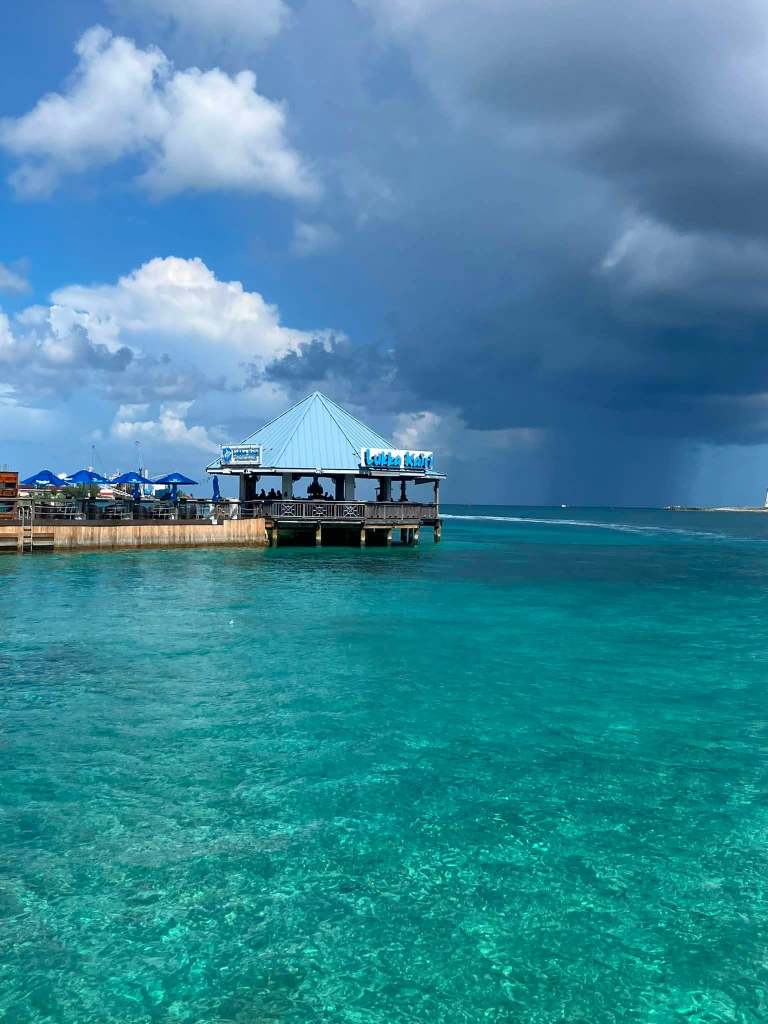
Wandering Nassau port shops, I was overheated and ready for something cold to drink. I stopped to read a waterfront restaurant menu board.
A local man approached from behind. “Were you a model?”
I laughed. “No.”
“You walk like a model.”
Oh, good grief.Here we go again. What the hell is in the water here?!
After several days of maritime mating rituals, I had begun interpreting every compliment as a bad opening line.
He introduced himself as James, the owner of the restaurant, and asked if I wanted lunch.
When I explained that I was dehydrated, he invited me inside, poured me an iced tea and turned the fan toward me.
And that was it. No pitch. No maneuvering. No attempt to convert kindness into an invitation.
We talked. I thanked him for the cold drink.
He wished me well, and I continued down the boardwalk.
Not every compliment is a pickup line.
Sometimes, respectful communication is simply a pleasant exchange with no expectations attached.
The Travel Tribe
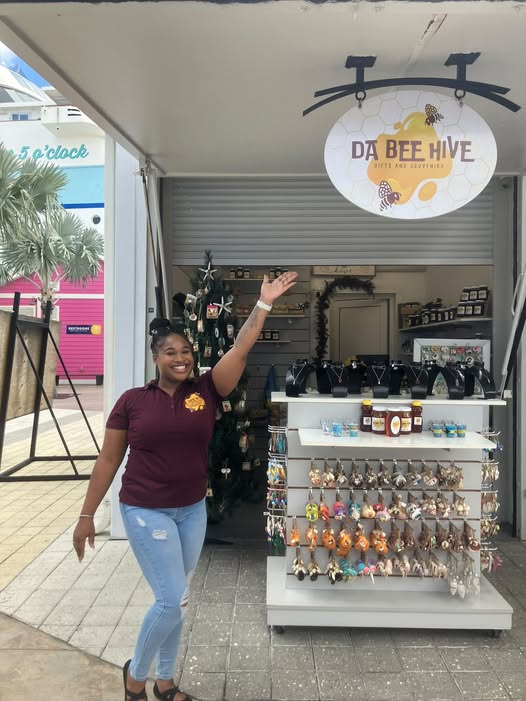
Somewhere amid the Nassau heat and humidity, I wandered into Da Bee Hive Shop and met Bee.
Her family is involved in local beekeeping, but what I remember most is her.
She has one of those infectious smiles and laughs that makes you want to stay and talk.
I wandered away. Then wandered back.
Every time she spotted me nearby, she laughed.
“I see you over there!”
I bought one of her handmade shell Christmas ornaments but will definitely sample the honey products on my next visit.
I asked whether I could take her photograph and explained that I sometimes feature memorable people I meet while traveling.
She lit up.
Then I told her: “You’re part of my travel tribe now.”
She responded with a beaming smile that told me she was officially in.
The People Who Make the Cruise
Thankfully, the cruise wasn’t all wildlife.
There was Priscilla at the St. Somewhere Spa.
I opted to stay on the ship in Freeport and booked a full-body massage.
I returned to my cabin and promptly fell into what can only be described as a massage coma.
I woke hours later wondering what had happened to the afternoon.
That may be the finest review of Priscilla’s work I could possibly give.
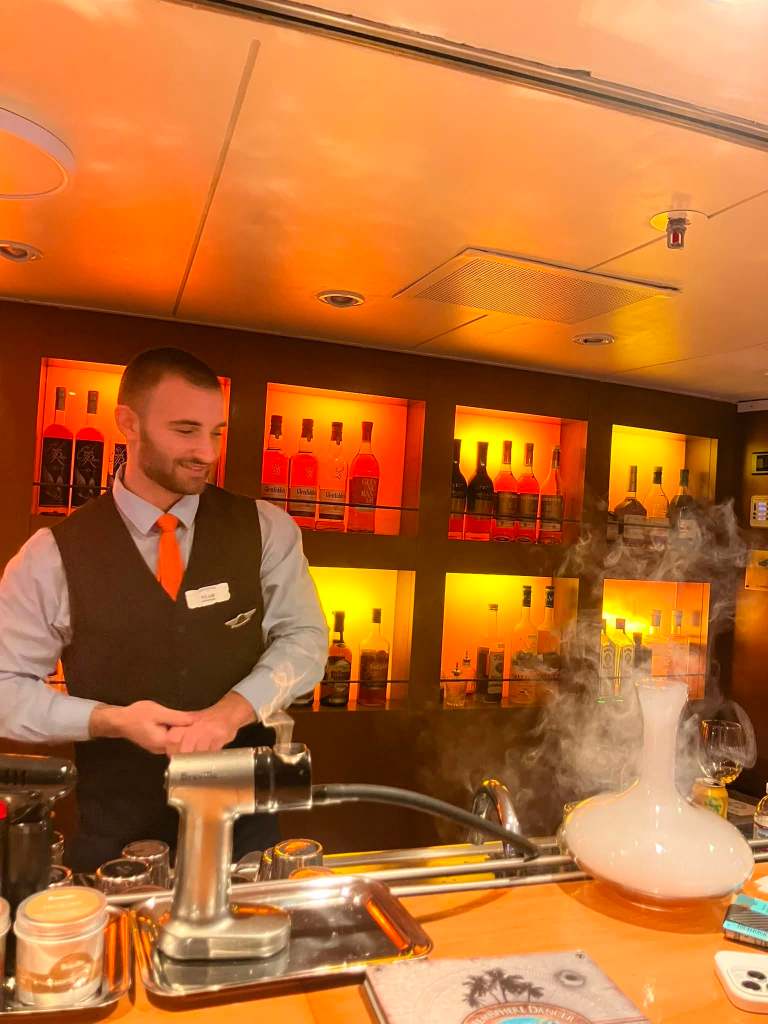
There was Vlad at the Hemisphere piano bar who entertained me with a smoky cocktail creation that looked less like bartending and more like a science exhibit involving alcohol.
There was Mario in Euphoria, who spotted me on the first evening and laughed:
“Weren’t you just here last week?”
Close enough to make me feel like a regular.
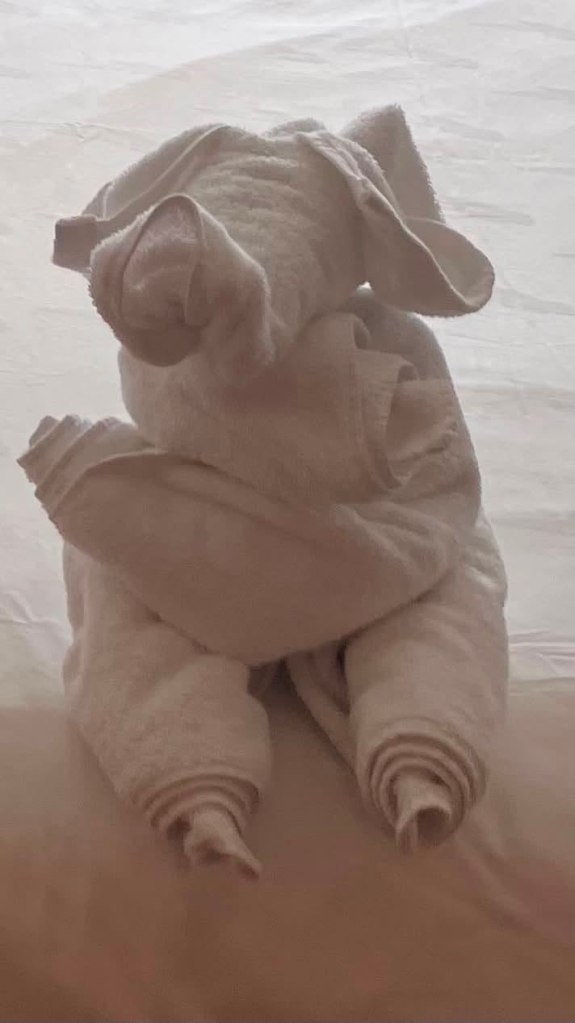
And there was Tyo, my cabin steward, who quietly made my trip easier every day. When my eyes were irritated – possibly from mouthwash fumes — I asked for ice to make cold compresses.
From then on, he kept the bucket full.
And because excellent cabin service always includes whimsy, he also left adorable towel animals behind.
Cruises may be built around ships, ports and itineraries.
But the experience comes from the people working onboard.
And Then We Tried to Go Home
You might think stepping off the ship ended the field research.
Bernadette and I shared an Uber to the West Palm Beach Brightline station.
I went to the Premium lounge. She went to the regular lounge.
Then my phone lit up.
“OMG SECURITY! I was pulled over by security!!”
Well. That gets your attention.
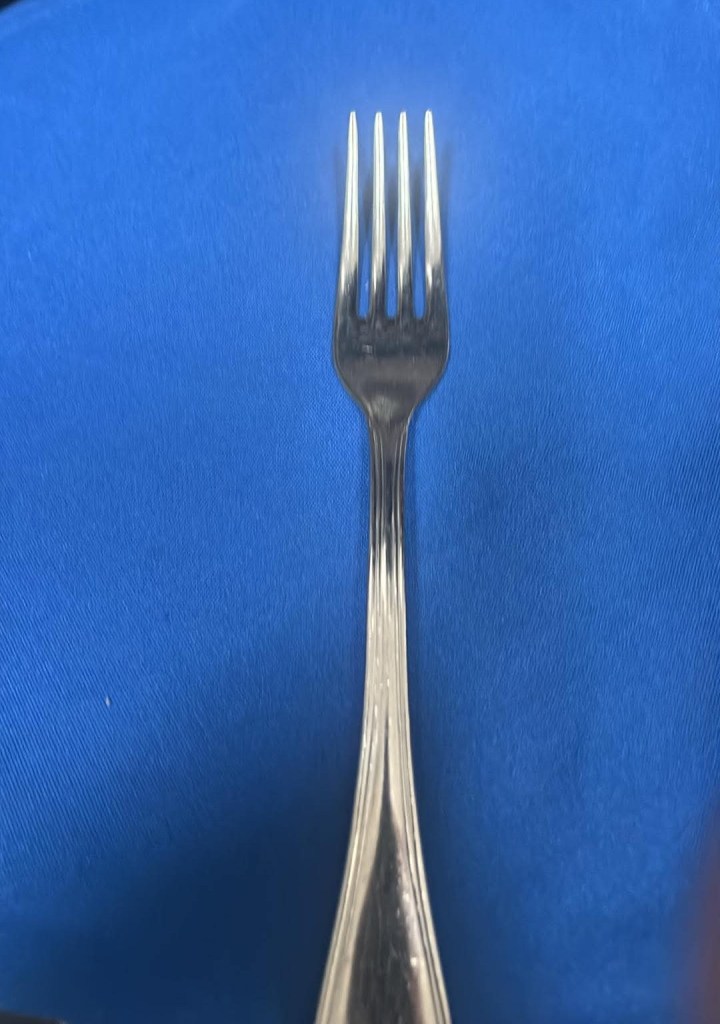
Apparently, Bernadette had put a blue buffet napkin containing a fork and knife into her purse that morning so she could carry her breakfast and coffee.
Then she forgot about it. Until Brightline security found it.
“You can’t carry a knife onboard.”
Bernadette was genuinely confused. “I don’t have a knife.”
Security produced the evidence: Blue napkin. Fork. Knife.
Bernadette studied it. “I’m a turkey head.”
Security confiscated the knife and returned the fork.
Bernadette looked at the fork.
Then at security.
“You don’t think I could stab someone with a fork?”
Oh, Bernadette. This would be an excellent time to stop helping security with hypothetical scenarios. 😂
The excitement didn’t end there. A short while later my phone pinged with another message:
“Oh my God, Jeanie. I’m on the wrong train.”
She had followed the crowd onto an earlier train and discovered, after departure, that she wasn’t merely on the wrong train.
She was going in the wrong direction. Toward Miami. We were going to Orlando.
The travel chaos never ends. Some people attract it. I apparently travel with it.
Final Thoughts
Solo travel should expand your world.
It should introduce you to people you never would have met, conversations you never would have had and places you might never have seen.
It should make you more confident, not more fearful.
Talk to strangers. Accept the kindness. Make the new friend. Laugh with the person at the bar.
Just do it with your eyes wide open.
By the end of the cruise, I had stopped wondering why the Lounge Lizards kept finding me.
Then it occurred to me.
Maybe I wasn’t attracting the wildlife.
Maybe I was the watering hole.
Enjoy the scenery. Know the wildlife. Trust your instincts.
Before the gentlemen start backing cautiously toward the exit, let me acknowledge the obvious: this works both ways. I’ve known women who used men as a meal ticket. I can’t write their field guide because I haven’t been on the receiving end of it. The Cringe Catalog is always accepting new submissions! Comments open! 😂
The Cringe Catalog: Lounge Lizards in the Wild
Most of us have been hit on more often than a piñata — but unlike a piñata, I don’t hand out prizes. In my twenties, I didn’t find it nearly as entertaining. The approaches were awkward and occasionally deserving of an intervention.
Decades later, the lounge lizards have aged. The delivery is slower. The material has changed. The mating ritual remains intact.
Field Research: The Cruise Ship Lizard
On a recent solo cruise, I encountered the floating lounge lizard.
I was sitting in the main lounge when a gentleman approached. No hello. No conversation. Just:
“Pucker up, Hot Lips.”
I replied:
“I’m sure my lip gloss has higher standards.”
And just like that… Hot Lips was denied landing clearance.
Field Notes:Stronger alcohol may be required to erase the visual. Survival Rating: 🦎🦎🦎🦎
Rule #1: Befriend the Bartender
Years ago, my friend Margaret and I went dancing at a nightclub in Delaware. Four engineers from work spotted us. Their leader, John, was an overconfident lothario.
Drinks began appearing behind us — Kamikazes, ordered eagerly.
Then the bartender tapped my shoulder.
“They’re trying to get you drunk.”
He’d seen this act before.
“I’m making your drinks virgin. I’ll tap you and hand you the virgin one.”
The engineers kept ordering. Margaret and I kept “drinking.” We remained perfectly sober.
When we left, we walked straight across the parking lot in three‑inch heels. The engineers staggered behind us. One lunged into my car window — apparently failing to notice it was still up.
Thunk. Forehead met glass. Engineer met pavement.
The next morning, John reported to my boss that I had “drunk them under the table.” I accepted the compliment. No need to correct the record.
Bartenders see everything. Make friends with them. Tip accordingly.
Rule #2: Never Reward a Bad Opening Line
The Computer Geek
Line: “Are you a keyboard? Because I think you’re my type.” Comeback: “Delete.” Field Notes:Terrible. Unfortunately, I laughed. Survival Rating: 🦎
The Romantic Optimist
Line: “Do you believe in love at first sight, or should I walk by again?” Comeback: “Keep walking. That line was dead on arrival.” Field Notes:Ancient material. Points for commitment. Survival Rating: 🦎🦎
The Technologically Challenged
Line: “My phone’s broken. It doesn’t have your number in it.” Comeback: “And it never will.” Field Notes:Technology has spoken. Survival Rating: 🦎🦎
The One Who Almost Pulled It Off
Line: “You seem like trouble. I’m in.” Comeback: “Okay. Sign the waiver. And buy me a drink.” Field Notes:Risk acknowledged. Application conditionally approved. Survival Rating: 🦎 Enough alcohol — that one might actually work.
Rule #3: When Necessary, Return Fire
One evening, the office cad wandered over to my barstool.
Line: “You get three wishes.”
I took a slow sip of wine.
Comeback: “How about I wish you were gone?” Field Notes:He gave me three wishes. I only needed one. Survival Rating: 🦎🦎🦎🦎
Rule #4: Never Underestimate Audacity
The Opportunist
Line: “I looked at you and lost my train of thought. I think you owe me a beer.” Comeback: “Your system failed, and I get a bar tab?” Field Notes:Cheap‑date warning. Payment denied. Survival Rating: 🦎🦎
The Optimist
Line: “Ooh la la… I think you need to date me.” Comeback: “Sorry. I don’t date for community service hours.” Field Notes:Confidence exceeded market value. Survival Rating: 🦎🦎
The Straight Shooter
Line: “How about we finish these drinks and start making bad decisions together?” Comeback: “Do you have references?” Field Notes:Refreshingly honest. References requested. Decision pending. Survival Rating: 🦎🦎🦎
Rule #5: Escape Routes & Strategic Seating
Years of traveling solo taught me that location matters. I prefer an end seat at a bar — easy access to the bartender, clear view of the room, and most importantly, an unobstructed escape route.
Know the exits. Carry a crossbody purse. And never underestimate the tactical value of landscaping. A strategically placed palm can provide valuable cover.
Rule #6: Master the Art of No
Not every Lounge Lizard requires tactical deployment.
Being friendly never obligates you to entertain anyone. A drink doesn’t buy your phone number.
Rule #7: Know When It Turns Toxic
You moved. He followed. This is important scientific data: the specimen has failed to comprehend the escape attempt.
Change tactics. Be direct. Move toward the staff. If he follows you outside, recruit backup.
Rule #8: When the Rating Scale Breaks
Corporate America unleashed a new species: The Professional Lounge Lizard.
One particular boss — married, self‑proclaimed ladies’ man — once blocked my exit, looked down at me suggestively, and said:
“You look delicious today.”
I blinked. Hard.
Then he added:
“I never eat anything strange unless she’s really worth it.”
My brain refused to process the incoming data.
Actual Comeback: “That was totally inappropriate.” Field Notes: This behavior escalates. Request reassignment. Survival Rating: 🦎🦎🦎🦎🦎🦎🦎🦎🦎🦎 Some comments deserve their own HR file.
Rule #9: A Pickup Line Does Not Require a Participation Trophy
The Migratory Lounge Lizard
Recently, I was walking across a Walmart parking lot when a man noticed me from a distance. He followed me inside.
Line: “You have the sexiest walk I’ve ever seen. I had to follow you all the way in the door.” Interrogation: “Are you single?” “Available?” “Can I have your number?” Comeback: “No, that would be a hard pass.”
He persisted.
Line: “Can I hug you?” Comeback: “For what?! You’re about to shop alone.” Field Notes: Crossing the entire parking lot does not earn a participation trophy. Survival Rating: 🦎🦎🦎 Final Disposition: Return this specimen to the wild.
Rule #10: When Subtlety Fails, Remove All Ambiguity
And then there was Mike, the Neighboring Lounge Lizard. Unfortunately, this specimen lived in the same apartment building.
After a group happy hour where Mike supplied the wine and charcuterie—and then counted how many pieces each of us ate—the red flags began multiplying.
Eventually, he approached me in the parking lot.
Line: “I want to take you to lunch.” Comeback: “No, I’m not interested.”
“You’re not interested in lunch… or me?”
He requested clarification. So I gave it to him.
“Neither.”
Field Notes: Persistent specimen. Failed to respond to normal deterrents. Survival Rating: 🦎🦎🦎🦎🦎 Final Disposition: Long-term habitat management required. Do not feed the wildlife.
Final Field Notes
Most Lounge Lizards are harmless. They are funny, charming, and painfully corny. A rare few are clever enough to make you laugh despite yourself. And some should never be permitted to open their mouths after the first cocktail.
But here’s the most useful lesson:
You can be friendly without being available. You can laugh without encouraging. You can say no without apologizing. And you can enjoy a bar, restaurant, nightclub, or cruise ship lounge by yourself without owing anyone else a seat at your table.
Sometimes a polite smile is enough. Sometimes you move. Sometimes you recruit the bartender. And occasionally… You return fire.
I truly believed I’d wrapped up my Lounge Lizard study. Then the universe whispered, “Hold my cocktail.”
A new specimen opened his mouth, and out tumbled fresh, premium-grade nonsense.
Earlier this month, my Coastal Cowgirl adventure took me on a four-night escape from Palm Beach to Key West and Freeport.
The ship is older but nicely renovated. Its smaller size is part of the appeal. Just enough activity, entertainment, and dining to keep you busy without the overwhelm of a mega-ship.
Food is typical cruise fare, but I like how the buffet is divided into food-court-style stations, with plenty of additional dining options.
Key West
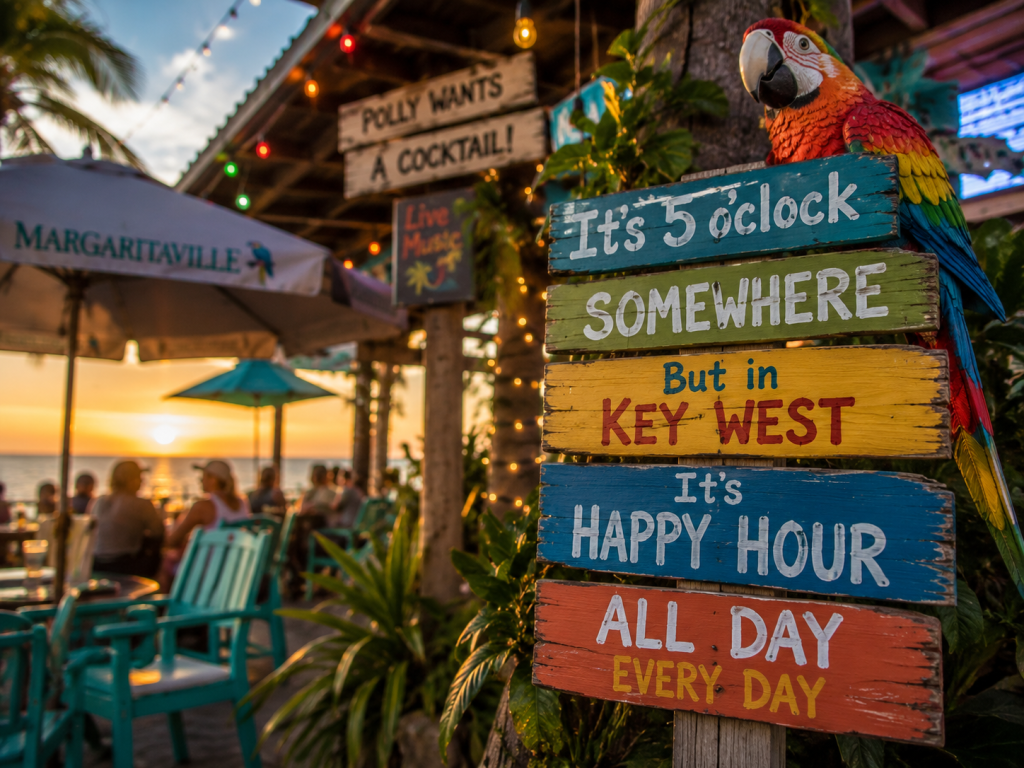
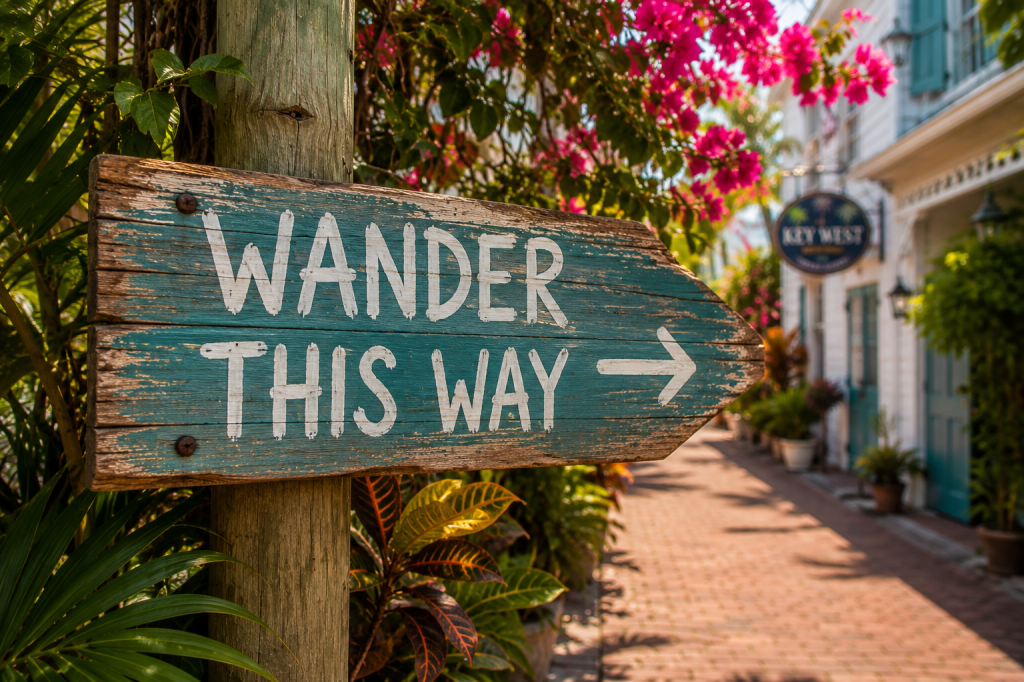
Key West doesn’t greet you—it ambushes you with pastel charm, loud chickens, and the undeniable urge to buy a tropical shirt.
I wasted no time embracing the local culture. Before 10 a.m., I was standing in line to sample the famous key lime pie. It was there that I met Nick. With my ship sailing later that afternoon, he had until 3 p.m. to show me the best of Key West.
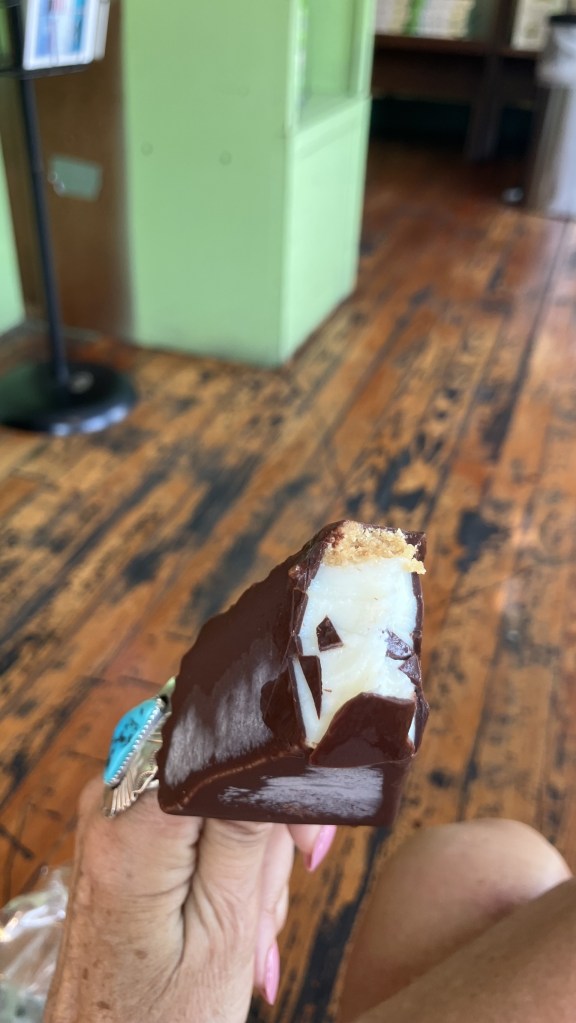
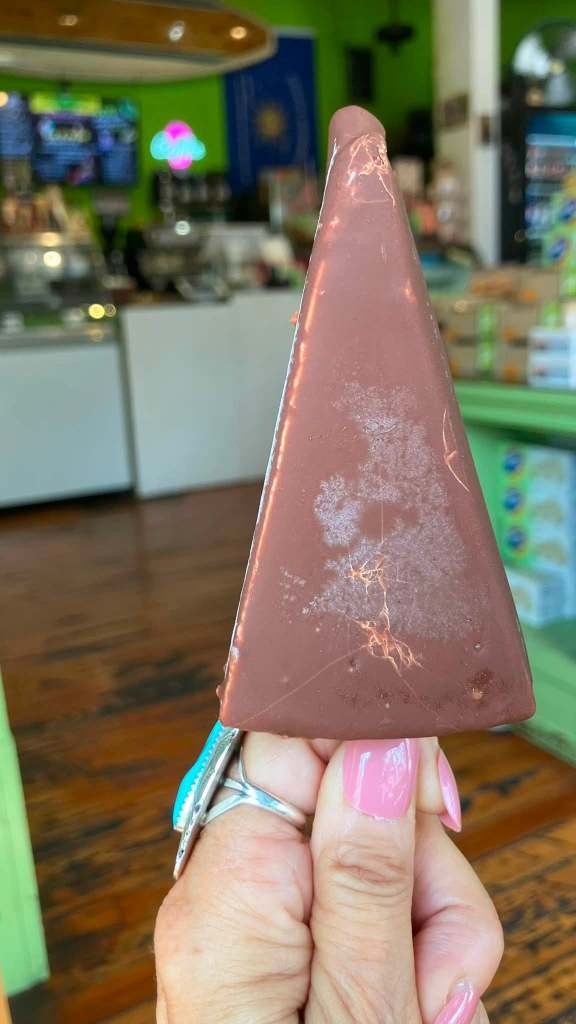
The chocolate-dipped frozen key lime pie truly needs to come with an addiction warning.
Duval Street is an irresistible mix of coastal charm and unapologetic eccentricity.
We walked to the Southernmost Point, stopped at the butterfly exhibit, browsed galleries and shops, and enjoyed Key West’s unmistakably quirky character.
Artful Detours
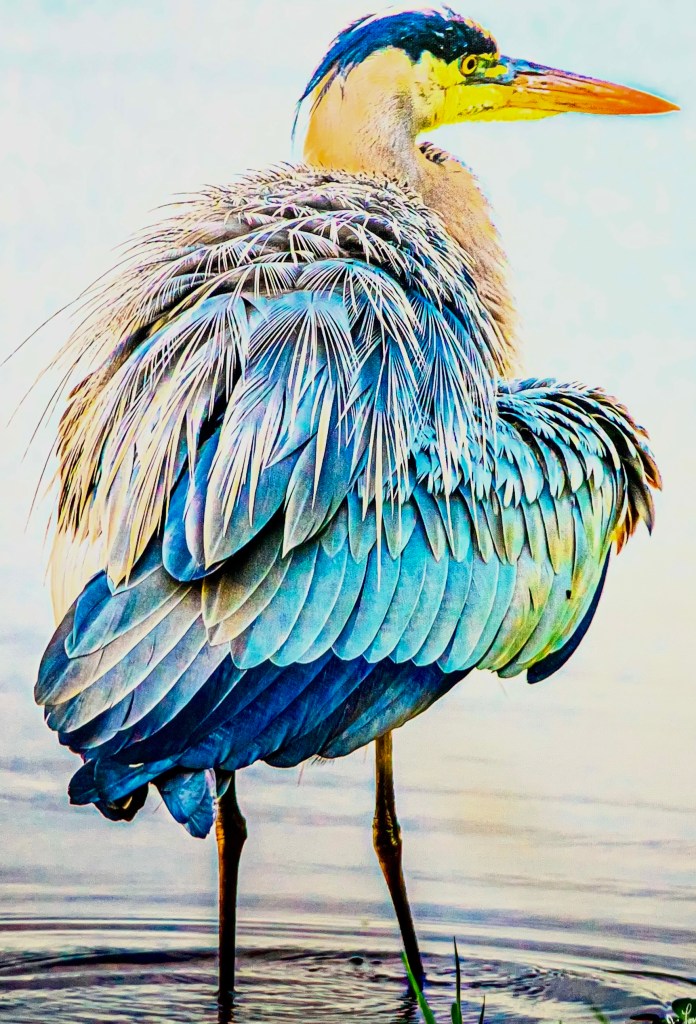
I purchased a giclée print by Florida Keys photographer Jack Louden titled Rhapsody in Blue. It features a blue heron with ruffled feathers and a slightly disheveled attitude.
Island Vibe
Music spills out of every other doorway along Duval Street. Bars and restaurants feature live performers with that laid-back energy that makes you want to find a seat and recover with a cold drink.
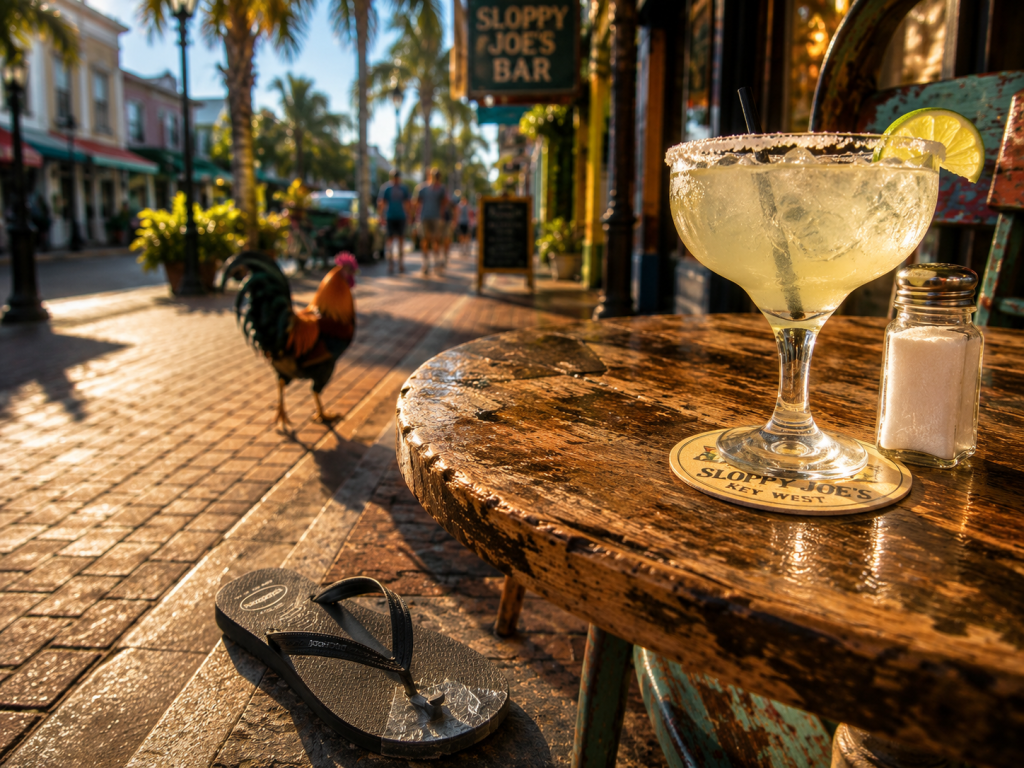
Sloppy Joe’s had a live band playing. It’s not a sandwich shop—it’s more of a Key West personality test.
By night, Nick explained, the volume goes up, and the party spills right onto Duval Street. You’re either walking past it—or joining the fray.
Freeport, Grand Bahama
Freeport had an entirely different energy, so I opted to stay on the ship and conserve mine.
A wise decision. Some of the best entertainment was still to come.
No Rhythm – No Problem
Every cruise ship has its legends.
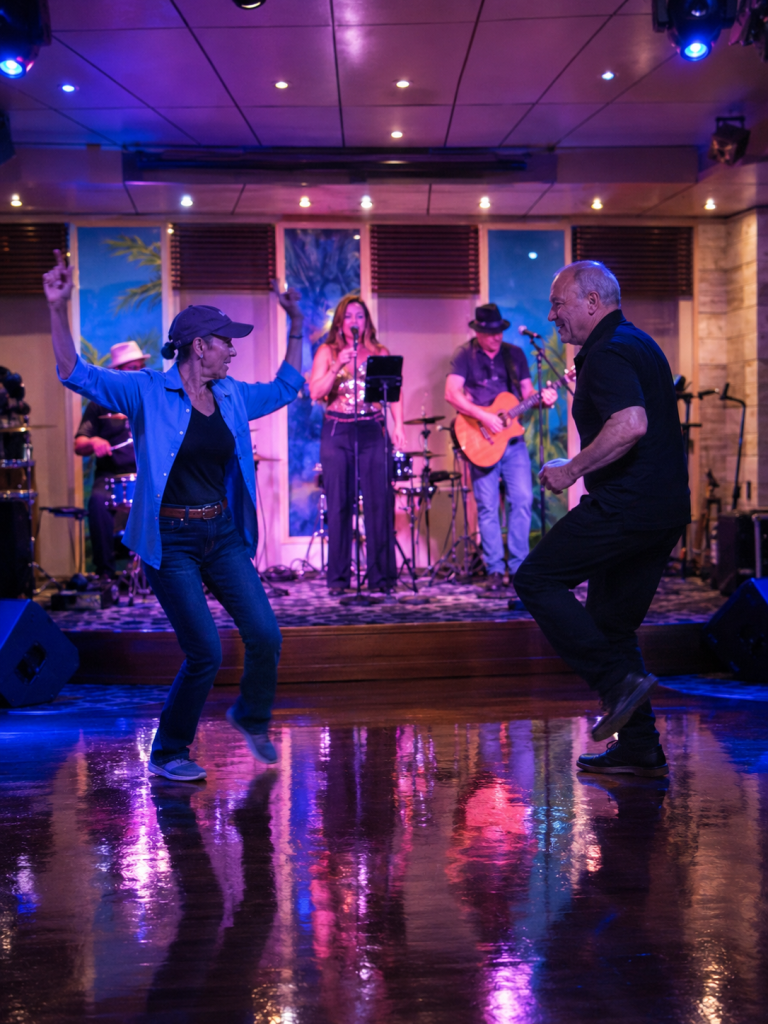
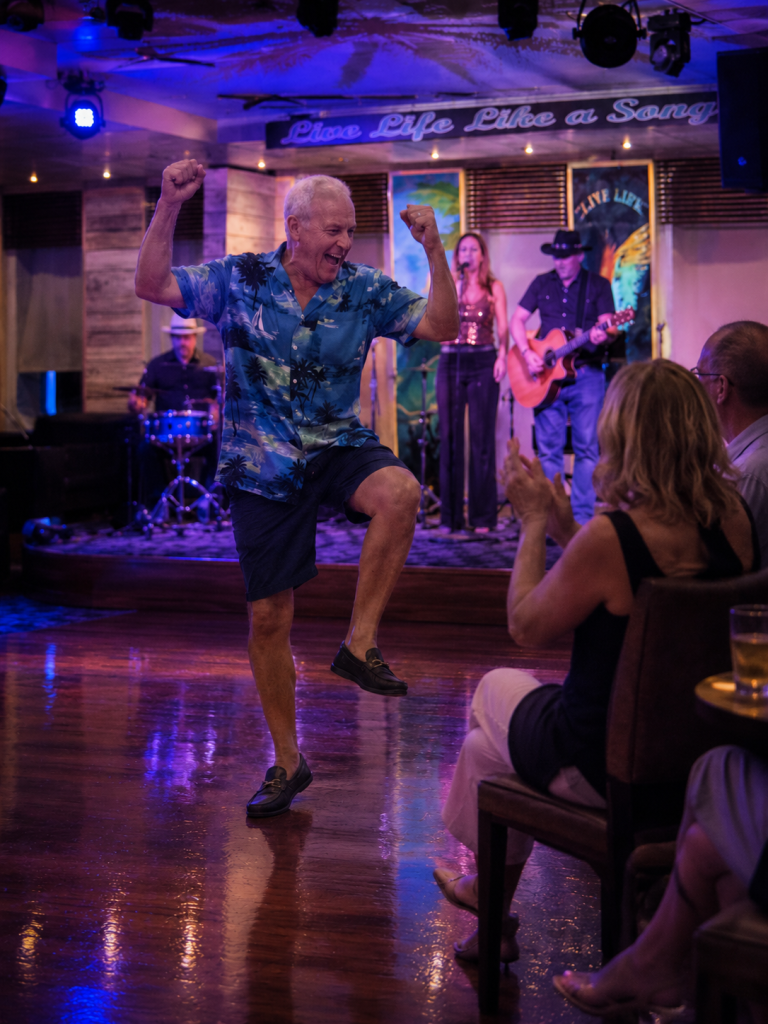
On this sailing, they arrived as a matched set. Two older brothers—gray hair, matching island shirts, and the unmistakable confidence of men who believed they absolutely had the moves.
They didn’t dance so much as stomp grapes. Feet pounding. Arms flailing. Jumping, skipping—trying to keep up with every musical beat.
They had the exact same moves. It was like watching a comedy sketch in unison.
And honestly, you had to admire them. What they lacked in rhythm, they more than made up for with enthusiasm.
One brother had a dance partner—a tiny, joyful woman who floated around the dance floor with her arms in the air, prancing like she was performing a slow‑motion strut. She was in her own happy little world.
The audience loved it.
Phones came out. People laughed. Not because anyone was being cruel, but because it was impossible not to smile while watching someone completely lost in the moment.
The second brother had a different approach. He had no dance partner—so he simply went shopping for one.
He surfed the audience like a man on a mission, approaching every woman in sight. That included married women seated with their husbands, which was bold… and deeply optimistic.
The Euphoria Lounge had its own herd that night, reminding me that life is too short to sit on the sidelines waiting until you’re perfect.
Sometimes you just have to get out there and dance—to whatever beat you hear.
Lip Sync Gone Wild
The lip sync contest turned into a comedy audition.
These people came ready to win.
There are extroverts… and then there are performance artists.
The finalists chose their songs and costumes. They danced on bar tables. They slithered down stairwells. Men took off their shirts and tossed them into the audience like confetti.
But the winning performance belonged to a woman who chose Whitney Houston’s “And I’m Telling You, I’m Not Going.”
She didn’t just perform for the audience.
She selected a co-star.
And she chose wisely.
The gentleman she singled out was watching from the stairwell.
He was in.
She took his hand, led him to center stage, and continued the performance directly into his ear.
He reached back and affectionately touched her thigh.
Apparently, he was really in.
By the final verse, they were embracing while she somehow managed to stay committed to the performance.
The song ended. They did not. The host finally had to separate them.
And yes—she won the free cruise.
There’s something about a cruise ship that gives people permission to leave their inhibitions at the dock.
Service at Sea
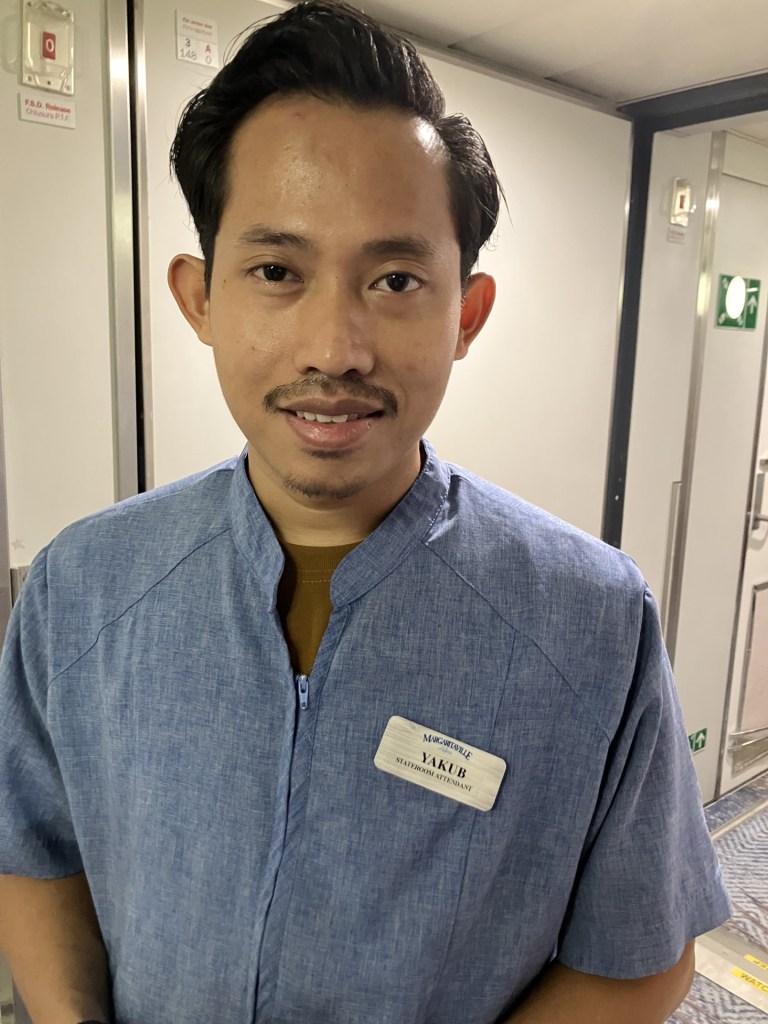
My room attendant, Yakub, was quietly attentive without being intrusive.
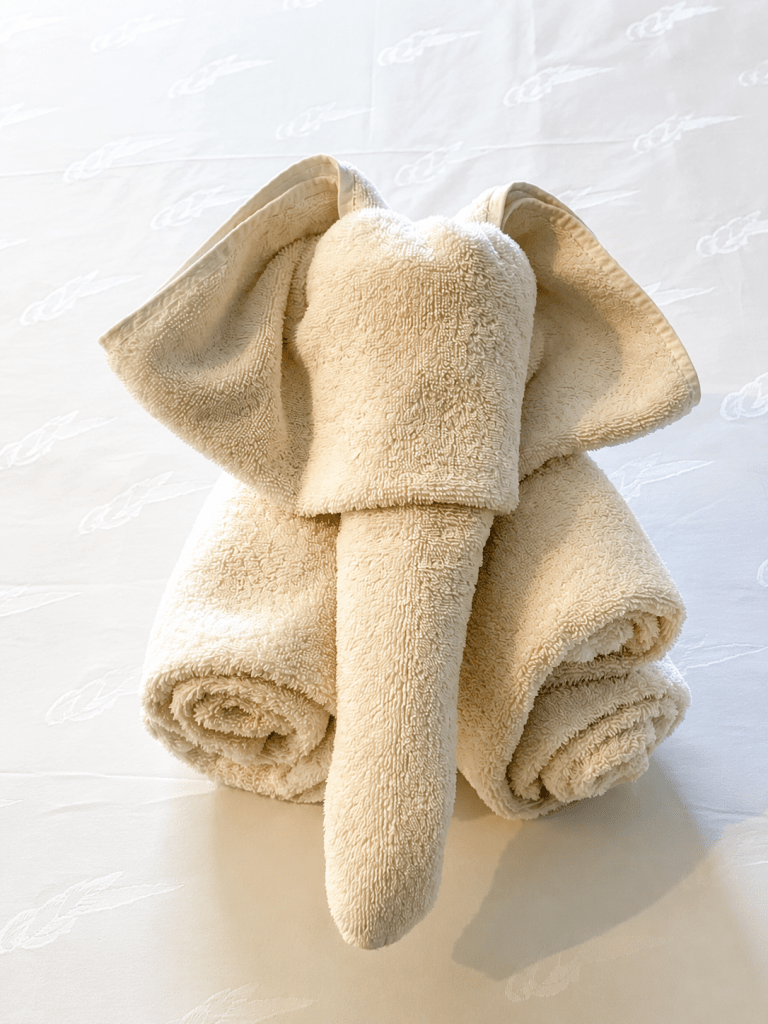
Each evening, I’d find an adorable towel animal waiting on the bed—one of those small touches that makes you smile.
Final Thoughts
Key West had been on my bucket list for years, and it did not disappoint.
It’s colorful, quirky, slightly unruly—and impossible to experience in a single day.
Maybe that was the theme of the entire trip: a little less restraint, a little more living.
I left Key West feeling like I’d only read the first chapter.
But I’ll definitely be back to see how the story unfolds.
Every great island story starts with something falling apart.
One of my favorite memories from this cruise wasn’t an excursion.
It wasn’t the turquoise water.
It wasn’t the chocolate-dipped frozen Key lime pie on a stick.
It was the day my flip-flop was taken hostage by another tourist… and I met the most notorious little outlaw in Key West.
It started innocently enough.
I was standing in line at a shop on Duval Street, patiently waiting for my chance to order the famous Key lime pie.
The tourist in front of me suddenly stepped backward.
Not a gentle bump.
Not a polite little shuffle.
His entire weight landed squarely on my right foot, pinning it to the floor like he’d staked a claim on Florida real estate.
My foot was trapped.
I pulled.
He leaned.
I pulled harder.
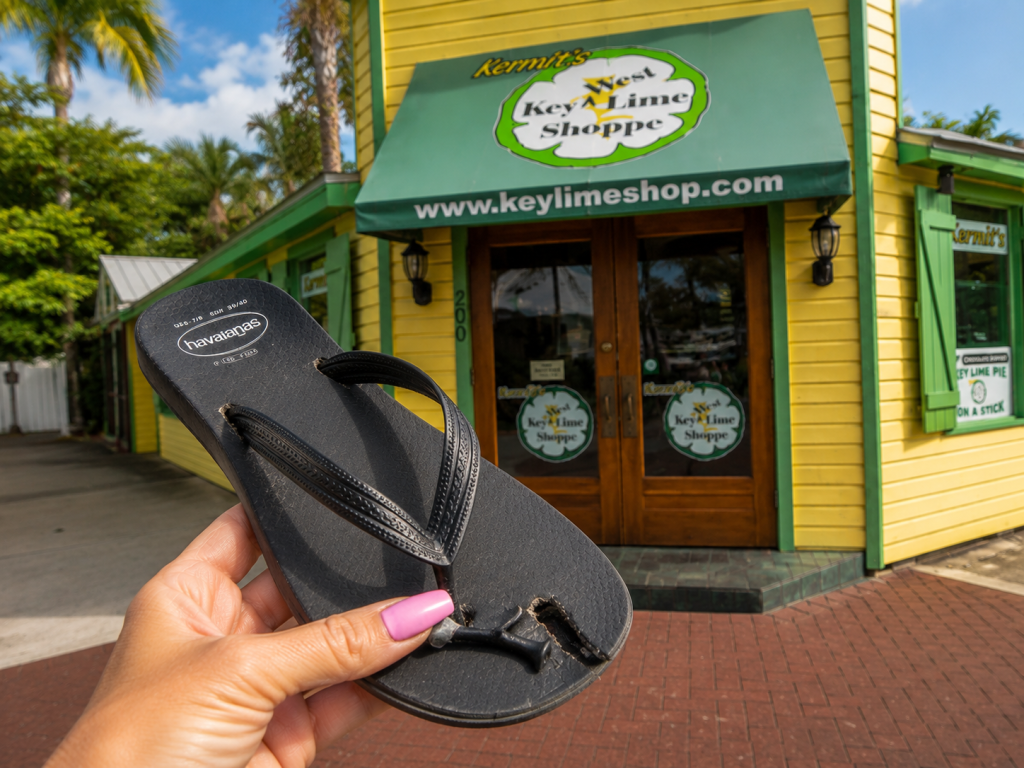
SNAP.
The thong of my flip-flop surrendered with all the determination of a beach umbrella in hurricane season.
One second, I was standing there taking in the vibe.
The next…
A tourist blew out my flip-flop.
And that’s when the guy standing behind me started laughing.
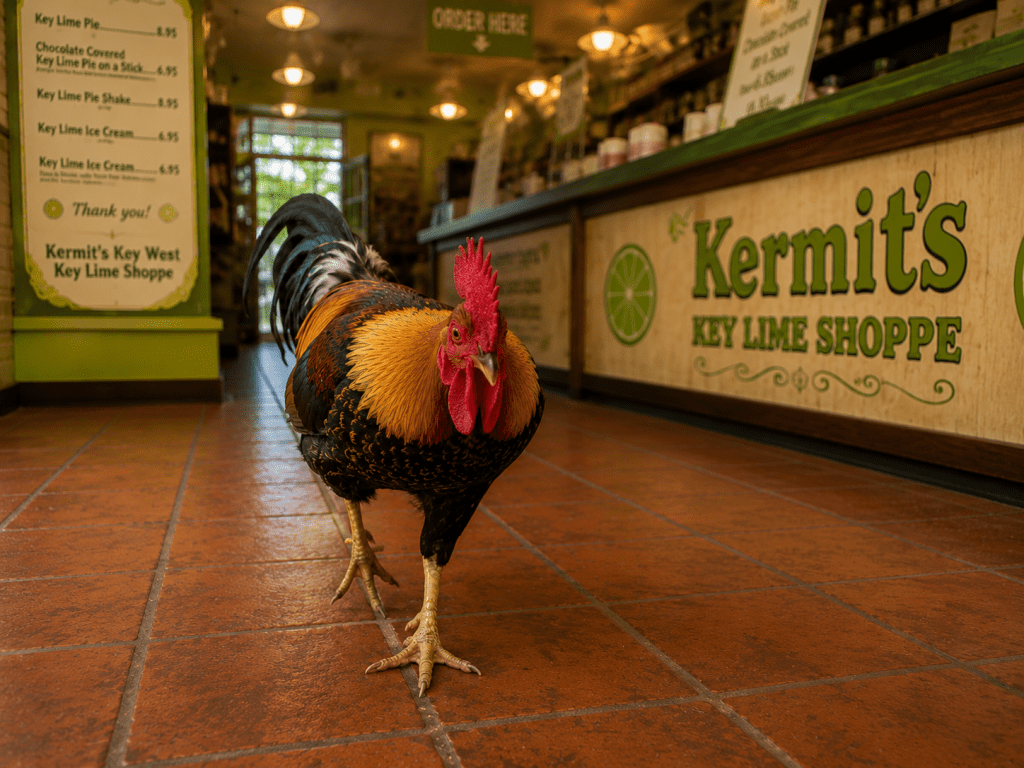
“Oh… you’re about to meet Brooster.“
I looked around.
“Who?”
He nodded toward a rooster strutting in our direction with the confidence of a six-inch-tall mob boss collecting protection money.
Apparently, Brooster is infamous on Duval Street.
Not because he’s friendly.
Or charming.
Or the unofficial island mascot.
Brooster is a feathered menace with a rap sheet longer than Key West.
Rumor has it that there are actual Wanted posters
While I was still trying to process that information, Brooster marched straight toward my flip-flop carnage like he’d just been dispatched to investigate the crime scene.
He stopped inches from my foot, puffed out his chest, cocked his head, and stared at my broken sandal with the expression of a detective who’d already solved the case.
Then he looked up at me and let out a loud crow!
I’m fairly certain that translated to…
“Well… that’s not good.”
Before I could object, he took one aggressive step toward my exposed toes.
I jumped.
He pecked, missed, and looked genuinely disappointed.
Then fate intervened.
A little girl walking by me gasped as her key lime pie slipped from her hands and landed on the ground.
Brooster scurried into action.
Within seconds, he was sprinting down Duval Street with a chunk of pie like he’d just robbed the First National Bank of Desserts.
A local glanced over, shrugged, and said,
“Yeah… he does that.”
As if grand theft pie by poultry was simply part of island life.
By now, I was laughing so hard I’d almost forgotten my flip-flop was hanging together by sheer optimism.
The guy behind me was thoroughly enjoying the spectacle.
“Well… Jimmy Buffett warned you.”
I couldn’t argue with that.
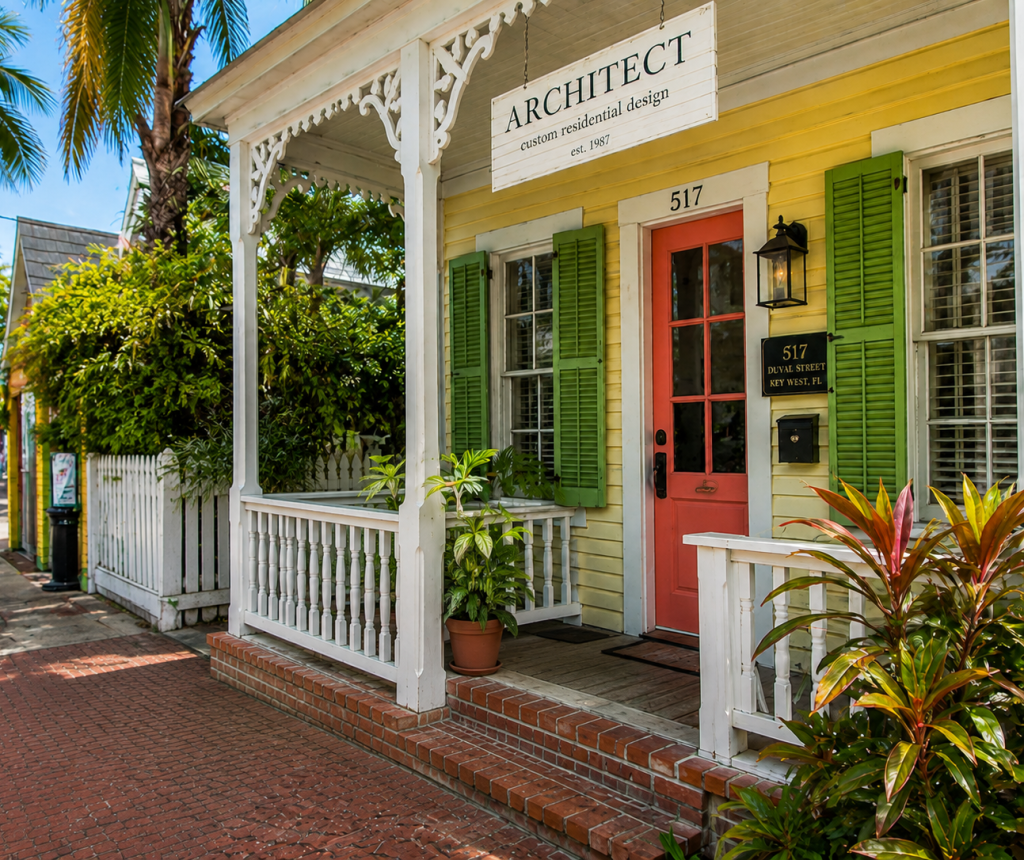
He introduced himself as Nick, an architect who split his time between Palm Beach and Key West on work projects. During those visits, he’d apparently sampled enough Key lime pie to qualify as a local food critic, so he insisted I order his favorite.
Then, before I could object, he quietly paid for it.
As I attempted to hobble away on one functioning flip flop, he looked down and said,
“Hang on… I can fix that.”
Now ladies…
There are few things more attractive than competence.
Especially when it’s unexpectedly applied to your footwear.
We wandered down the Street to his office, where, with the confidence of a man who had clearly repaired everything from staircases to seawalls, he rebuilt my flip-flop in just a few minutes.
Good as new.
Actually… better.
The rest of the afternoon unfolded without a plan.
Nick offered to show me a few local favorites.
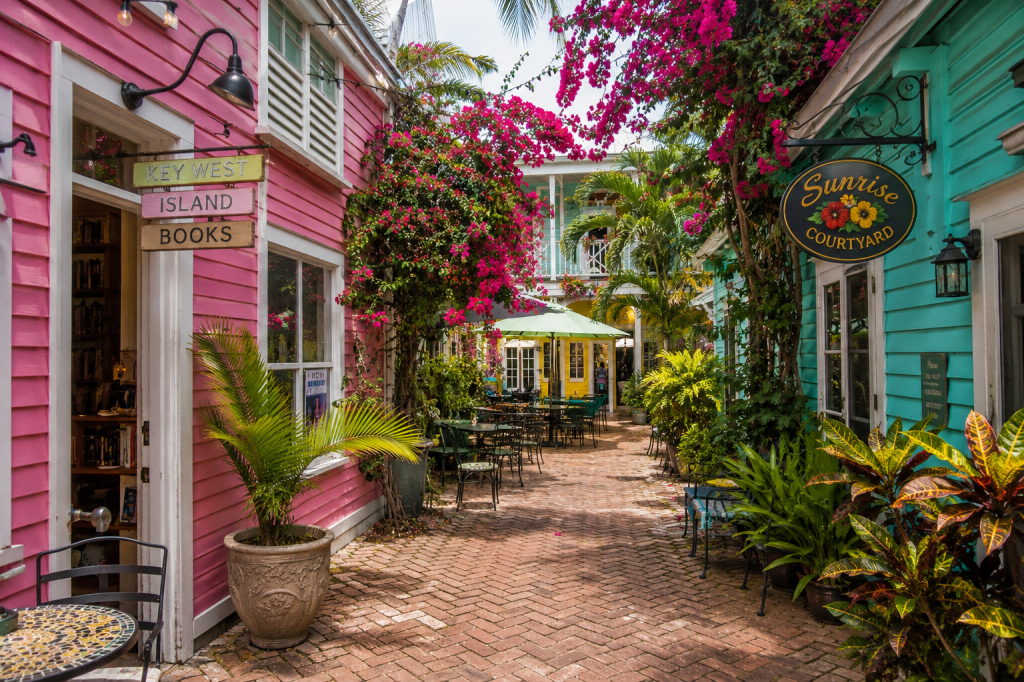
As we wandered Duval Street, we talked about travel, architecture, my fantasy barndominium design, and all the little places tourists usually miss. He pointed out hidden courtyards and his favorite shops and restaurants that most visitors would never discover on their own.
Every few blocks, a rooster strutted across the street like traffic laws were merely suggestions. After a while, I realized Brooster wasn’t the exception… he was simply the most accomplished member of the feathered gang that apparently ran Duval Street.
Before we parted ways, Nick asked what my plans were once the ship docked. I let him know I’d only be in West Palm Beach for a few hours, using a Hilton day pass before catching the Brightline back to Orlando.
We exchanged numbers, and I boarded the ship.
Quiet Storm
On Friday morning, we docked in West Palm Beach beneath dark skies. Thunder rolled overhead, and sheets of rain hammered the deck. I opened the Brightline app to adjust my train time, but the Friday route to Orlando is evidently prime real estate — every seat was sold out.
I was on the phone with the Hilton West Palm Beach, trying to sort out my suddenly complicated day, when my phone pinged.
It was a message from Nick: “Not the best pool day. I’m in Palm Beach. How about a museum and lunch?”
I was beginning to feel like one of Nick’s architectural projects. First the flip-flop repair, and now a rainy-day rescue. Apparently, I had become a work in progress.
Luckily, he offered to come find me rather than the other way around. This was a wise decision on his part.
Navigation has never been my greatest strength.
In the last few days, I had gotten lost driving to the Orlando airport at 5 a.m. to catch the train and turned around on the cruise ship so many times that I began to wonder if I had somehow entered a nautical version of Groundhog Day.
By the time we docked in Freeport, I was so exhausted from trying to locate myself that I slept through the entire day.
In hindsight, Nick’s rescue was less a romantic gesture and more a public safety measure.
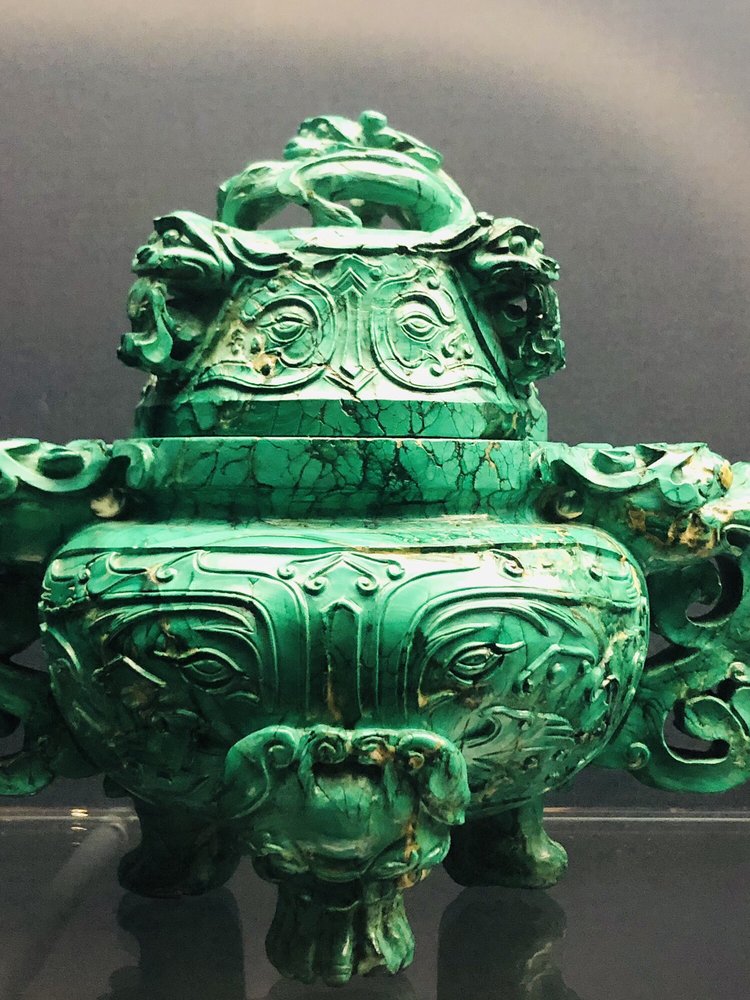
We spent the morning wandering through the Norton Museum of Art. I was especially drawn to the Chinese galleries, where centuries-old landscape paintings, jade carvings, and delicate porcelain reminded me how art can tell the story of an entire civilization.
It was pouring rain, so we settled into the museum’s restaurant for a casual lunch. The floor-to-ceiling windows offered a view of the sculpture garden.
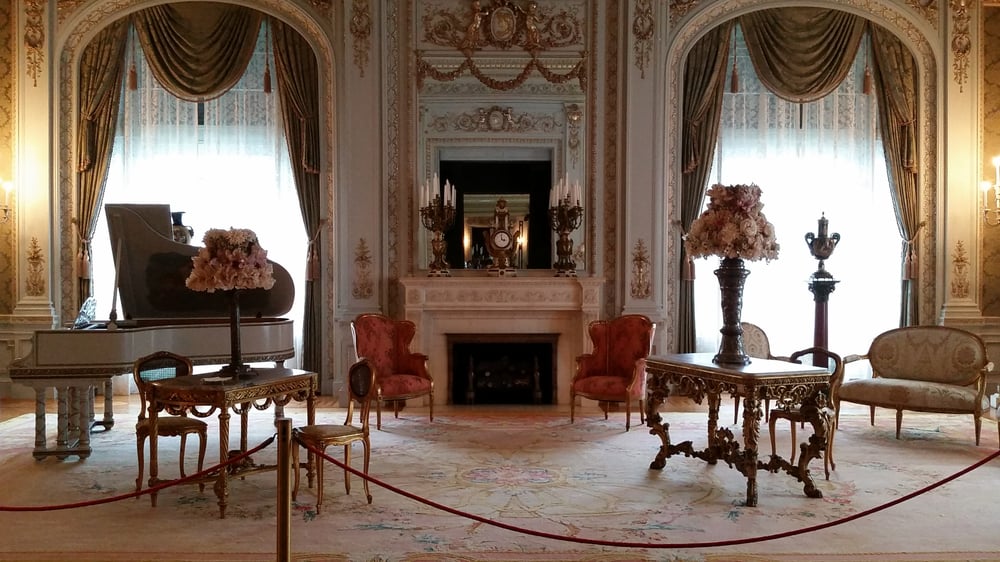
After lunch, we crossed the bridge to Palm Beach and wandered through the grand rooms of Whitehall, Henry Flagler’s Gilded Age mansion.
I somehow found myself in the middle of an impromptu architectural lecture — full hand gestures, historical context, and the unmistakable enthusiasm of someone who has been waiting years to explain cornices.
By late afternoon, the rain had given way to blue skies. We ended the day with a leisurely seafood dinner overlooking the Intracoastal Waterway before he dropped me at the Brightline station to board the train to Orlando.
Mr. Fix-It
Nick is now officially the newest member of my travel tribe — a group of wonderful people I’ve met along the way who remind me that the world is still full of kindness, generosity, and surprises.
Every travel tribe needs a few essential members: the navigator (which I clearly am not), the storyteller, the adventurer, and apparently, Mr. Fixit.
I’m not sure when Nick officially became Mr. Fixit, but the evidence was mounting. First, the flip‑flop. Then, the weather disaster. Give him a broken plan, a little chaos, and apparently, he’s in his element.
Turns out, every great island story really does start with something falling apart — a flip‑flop, a carefully planned itinerary, or a day that refuses to go according to schedule.
But sometimes those are exactly the moments that bring the greatest surprises, the kindest people, and the most unforgettable journeys.
Over dinner, I casually asked Nick if people ever tell him he looks a little like George Clooney. He considered it for approximately half a second and said, “Once in a while.”
Of course. Naturally.
But then he told me the funniest comment he’d ever received:
“If George Clooney and Pierce Brosnan had a love child, I think you’re it.”
I nearly inhaled a shrimp.
Final Thoughts
And that’s when I realized the Travel Gods had really been smiling down on me in Key West.
Not only had I met Mr. Fixit, but I’d also met a man who was intelligent, charming, and generous—all traits that create a solid foundation for friendship.
Forget the Key Lime Pie… THIS was the local attraction.
Well played, Travel Gods. Well played.
As I unpacked my travel case, I looked at the patched-up flip-flop.
Another memory in paradise… courtesy of a broken sandal.
Somewhere in Key West, Jimmy Buffett was probably humming a new tune.
🎵 “The blowouts are nothing but souvenirs with soles.”
Every year, we explored a different island — until Antigua made us want to stay.
We were booked at the Divi Anchorage Resort on Dickinson Bay between Christmas and New Year’s — one of those places you fall for instantly and start planning the return trip before the first one ends.
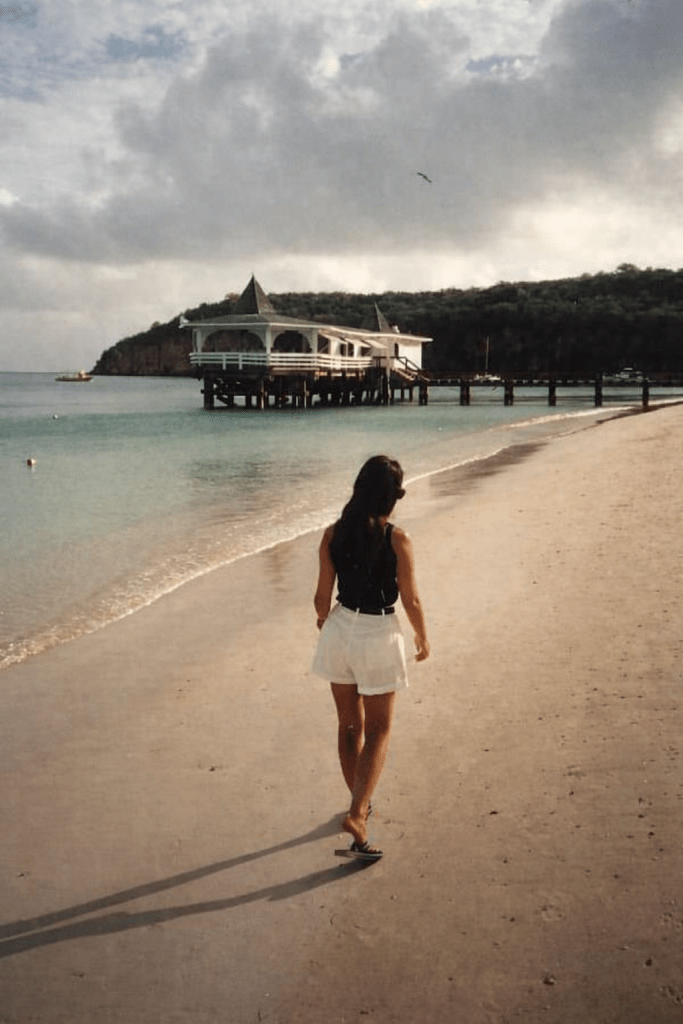
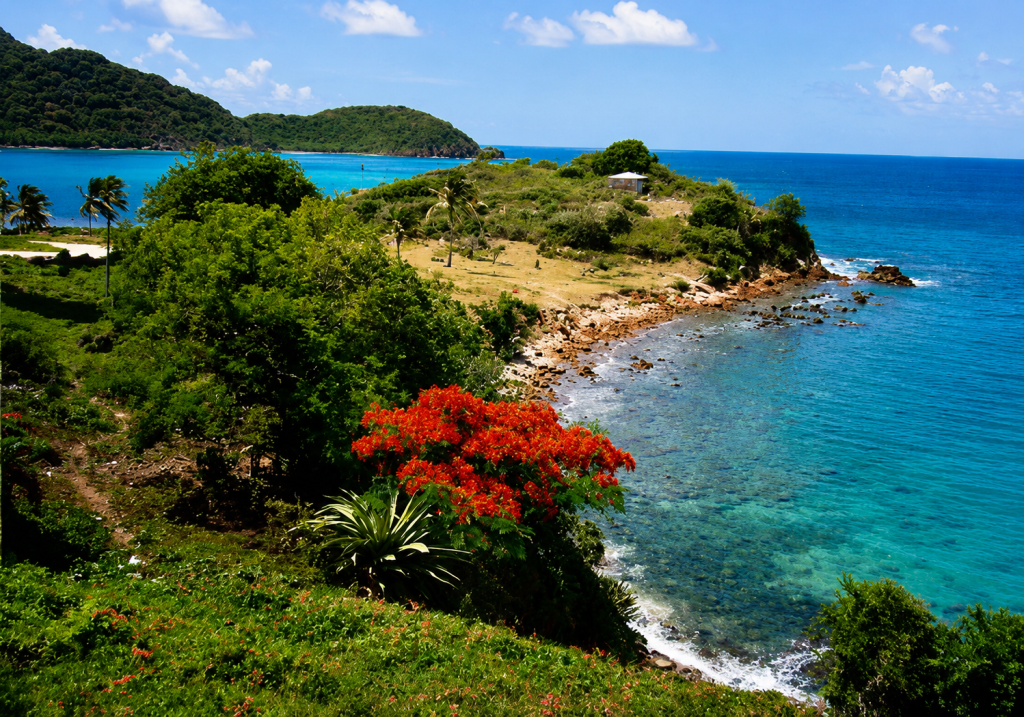
The Divi was located steps from the Caribbean, and the views were unreal — turquoise water by day, orange-pink sunsets at dusk, and the sound of the sea at night.
Two of our favorite places along Dickenson Bay were Miller’s on the Beach and Warri Pier. Miller’s served two-for-one cocktails for happy hour. Their pina coladas were outrageously delicious any time of the day.
Warri Pier
I booked a private trail ride at the St. James’s Club. At least three people at the breakfast buffet asked me where to go riding on the island.
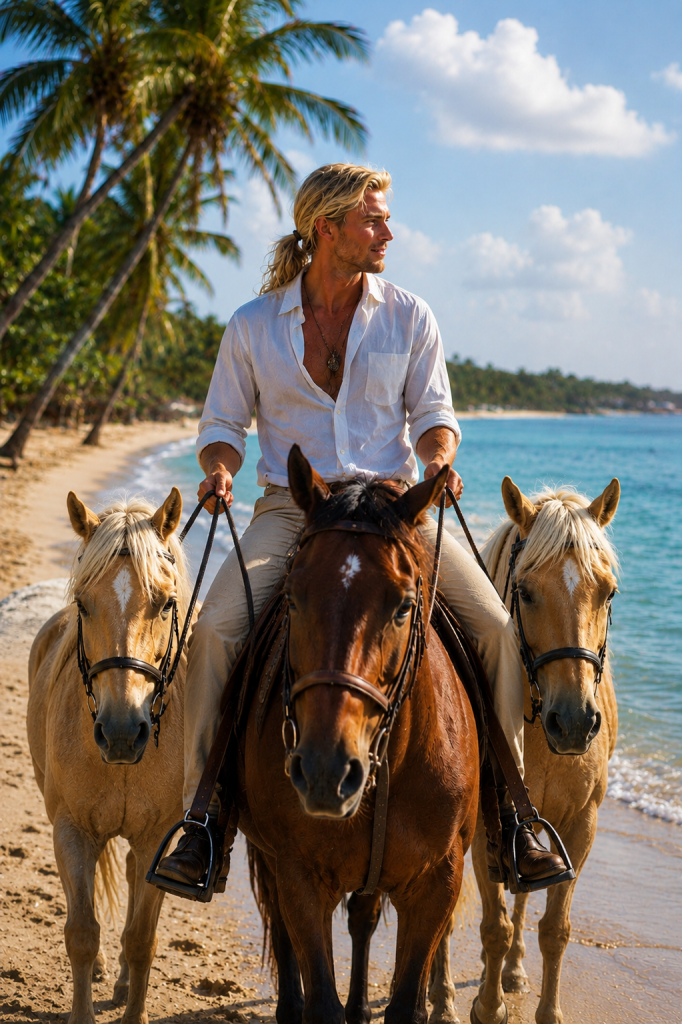
I arrived at the stable early and waited for the guide. In the distance, I saw a young man on horseback heading toward me, ponying two beautiful, palomino Quarter Horses.
Andrés looked like he’d stepped straight off the cover of a magazine — long blond hair pulled into a ponytail, an easy smile, and the relaxed confidence of someone who had spent most of his life in the saddle.
The ride began on dusty trails winding through the hills behind the resort, the kind of landscape where the air smells faintly of sunbaked earth and salt drifting in from the sea.
Somewhere along the trail, Andrés casually mentioned he was an Argentinian polo player. Because apparently, this was no longer a normal trail ride.
We rode through the hills talking about horses, riding, and island life until he asked, almost offhandedly:
“Have you ever played polo?”
I laughed and told him no.
“We’ll have to fix that,” he replied.
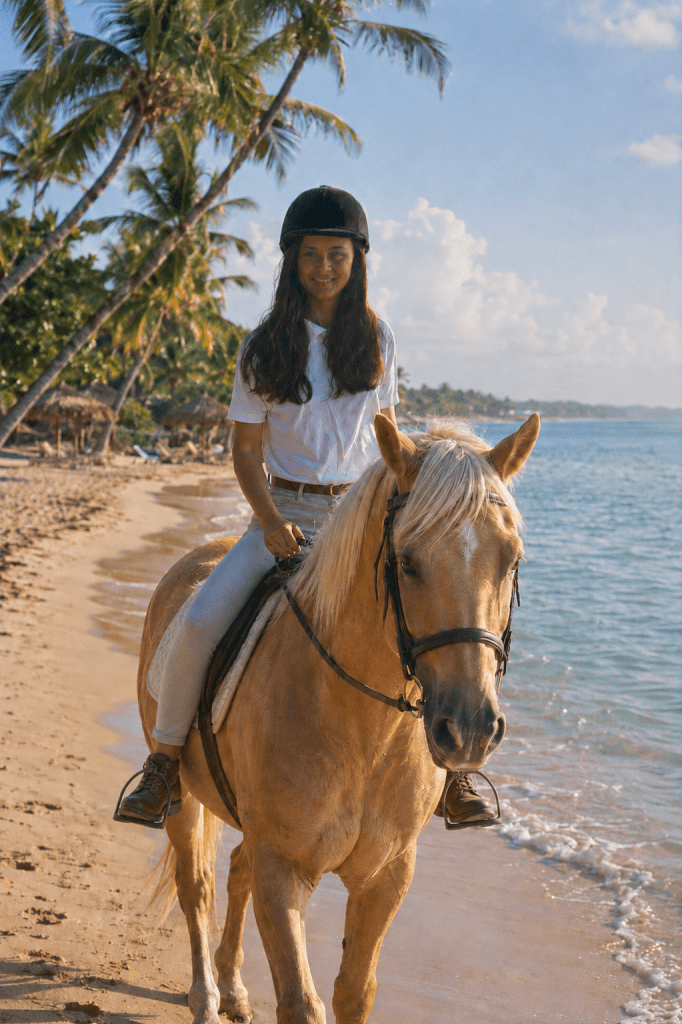
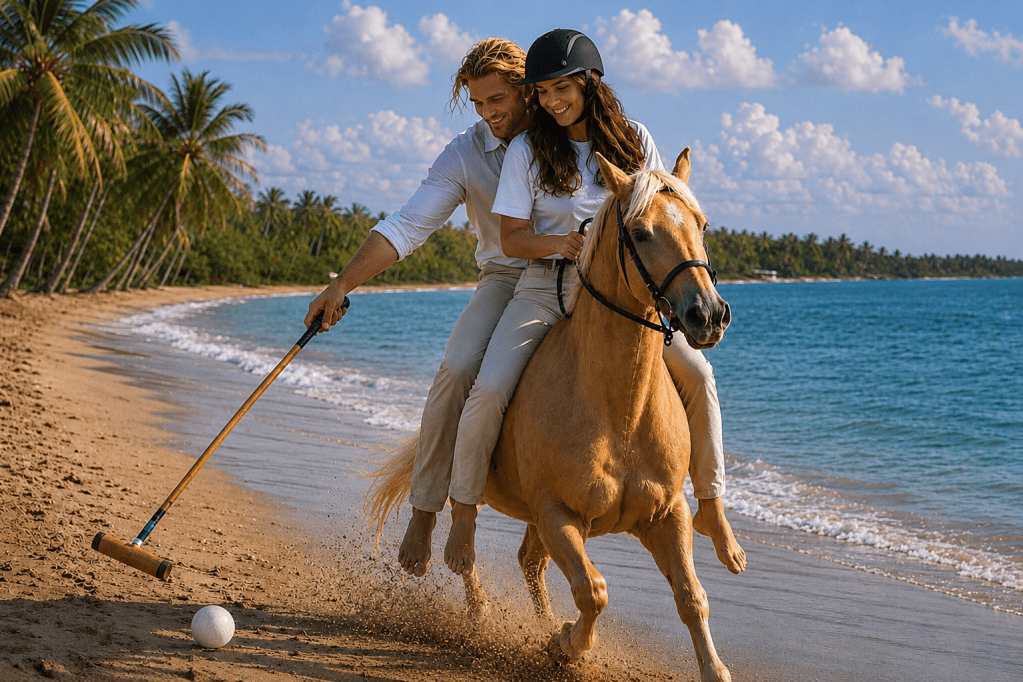
At the end of the ride, we returned to the stable where Andrés untacked the horses. Then, he offered me a leg up onto his horse and hand-walked us down to a quiet stretch of empty beach.
I could never quite figure out why his white shirt needed to be unbuttoned half the ride — but I wasn’t exactly complaining. It was, without question, top-tier island eye candy.
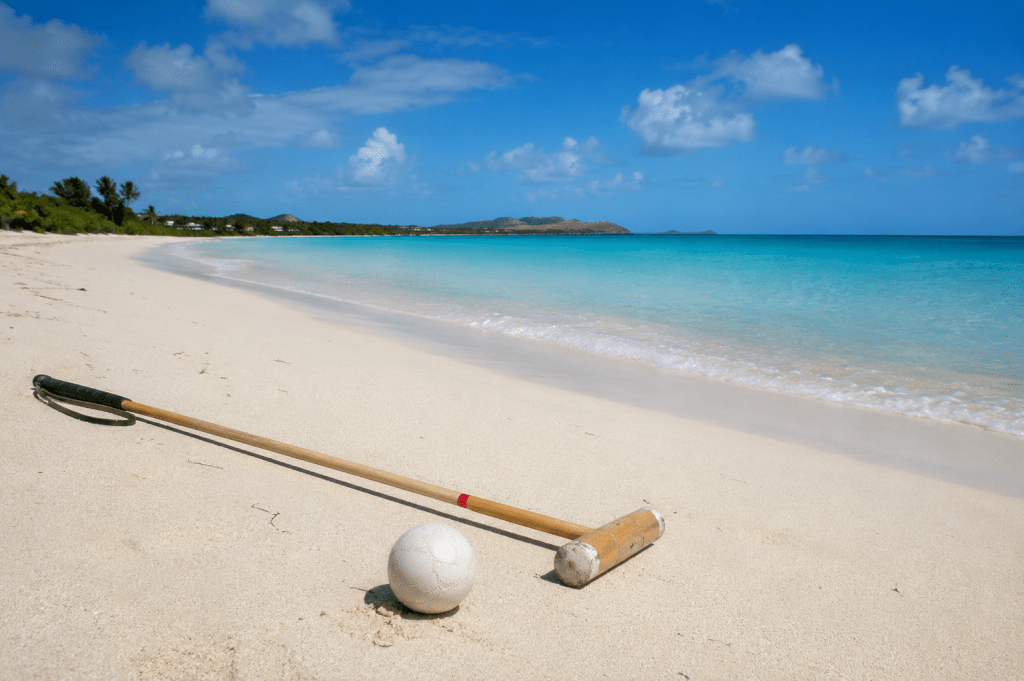
Waiting there beside the surf was a polo mallet and ball. I quickly surmised that this was Andrés’ practice field.
And just like that, my trail ride became my first polo lesson.
Because I already rode and had good balance, I picked up the basics quickly. My mallet connected more than once, knocking the ball down the beach while the horse surged forward beneath me.
I was feeling very proud of myself when Andrés decided we were moving into advanced instruction.
What happened next still feels slightly unreal. He swung up behind me like this was something he did every day.
Somehow, he managed to guide the horse, steady me in front of him, and drive the polo ball down the beach at a full gallop all at the same time.
We flew across the sand in sharp, sweeping turns while the surf exploded around the horse’s legs.
I remember laughing one second and hanging on the next, convinced I was either starring in the most outrageous travel adventure of my life—or about to become an international incident in Antigua.
It was exhilarating. Wild. Completely out of my comfort zone — but absolute perfection.
The lesson ended with a long bareback gallop through the shallows, the horse splashing effortlessly along the edge of the Caribbean surf.
Dining with the Stars
Antigua turned out to be exceptional in more ways than one — my first polo experience and an unexpected brush with celebrities.
Staying in one of the beach cottages at the Divi that week was Shari Belafonte and her husband, Sam Behrens, along with their extended family.
They had the long dining table beside ours for the entire week. At first everyone politely nodded over morning coffee and dinner service, but by the third day, we were greeting each other like old vacation friends. They could not have been nicer.
At one point, I accidentally called Sam ‘Jake’ — the name of his General Hospital character. The reaction was instant: the whole table erupted in laughter, Sam included.
I was mortified, but Shari leaned over, still laughing, and said, ‘Oh, that happens all the time. He’ll answer to just about any name.'”
The Divi hosted a New Year’s Eve party in the open-air dining pavilion overlooking the sea. Music drifted across the water, champagne glasses appeared before midnight, and at one point Shari ended up teaching half the resort how to do the Electric Slide.
Antigua became more than a vacation destination. It felt like a second home and we returned often.
Each visit, I rode the horses at St. James’s Club until the stable closed. I hiked trails through the hills above English Harbour, spent evenings at Nelson’s Dockyard, and watched sunsets from Shirley Heights. Those beautiful Caribbean places always felt timeless.
My favorite place to visit was Harmony Hall. It combined everything Antigua did well — the setting, the food, and that relaxed Caribbean atmosphere. The old sugar mill buildings and the waterfront location gave it a very different feel from the beachfront destinations.
The gallery there had a strong reputation — especially for Caribbean artists and colorful island-inspired work.
Harmony Hall has since closed in its original form; for many visitors it was a signature Antigua lunch destination. The drive out along the east coast and then sitting there overlooking Nonsuch Bay was part of the island experience.
One encounter that stayed with me was meeting artist, Katie Shears, at Seahorse Studios. A California transplant, Katie told me she had first arrived in Antigua on a sailing trip — and never really left. Before building her life on the island, she had worked as an animator for Hanna-Barbera. I left her studio carrying two of her wildlife prints, and they still hang on the walls of my home — small reminders of a place that quietly worked its way into my life.
Somewhere between the rhythm of the waves and the steady gait of the horse, Antigua became an important chapter in our story.
It slowly stopped feeling like somewhere we visited and started feeling like somewhere we belonged.