Notes from the Edge

Close enough to belong. Far enough to breathe.

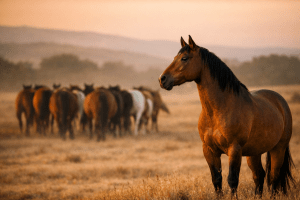
Even in a herd, there’s always one that drifts to the edge.

Not lost.
Not pushed out.
Just… not standing in the center.


It’s easy to assume that one is different.

Less connected.
Less involved.
Somehow outside of it all.

But that’s not what’s happening.


The one at the edge sees more.

The movement of the group.
The shift in energy.
The subtle changes before they become obvious.

They’re not separate from the herd—
just positioned differently within it.


I’ve realized, over time…
that I tend to live there.

Not completely alone.
Not fully in the middle, either.

Somewhere just outside the center—
close enough to belong,
far enough to breathe.


I’m outgoing.
I enjoy people.
I love meaningful conversation.

But I’ve never had a wide circle.
Never felt the need to be constantly surrounded.

There’s a quiet hesitation in me—
a little bit of shyness that never fully leaves.


And sometimes…
I do step into the center.

I lean in.
I engage more.
I try to stay there.

But it rarely lasts.


Not because something dramatic happens—
but because I start to feel it.

The noise.
The expectations.
The subtle misalignments.

And without thinking too much about it,
I begin to pull back.


I don’t make an announcement.
I don’t force distance.

I just… drift.

Back to the edge
where things feel clearer again.


It’s not about people being wrong.

It’s about knowing where I’m most myself.


Horses understand this instinctively.

They don’t cling to the center for comfort.
They move when they need space.
They return when it matters.

No explanation.
No second-guessing.

Just awareness.


There’s a quiet strength in that.

Not leaving—
just repositioning.

Creating enough space
to stay grounded
without losing connection.


Maybe that’s why the edge has always felt right to me.

Not because I don’t belong in the center—
but because I don’t need to stay there
to feel connected.


Because from the edge,
you can see the whole picture.

And when you step back in—
you do it as yourself.


I don’t leave the herd—
I just know where I stand within it.

From the Lessons from the Herd series
Storm Warning

Horses don’t wait for the storm to arrive.

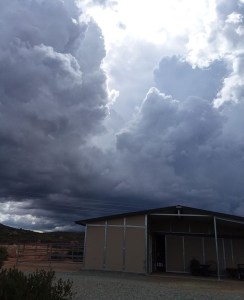
They feel it long before the sky changes—before the first drop, before the first sound of thunder.

The air shifts.
The energy changes.
The herd knows.

And they move.

We’re not built that way.

We get the warning… and stay anyway.


There’s always a moment.

It’s usually quiet. Subtle. Easy to dismiss if you’re not paying attention.

Something feels off.

Not wrong in a way you can explain. Not enough to walk away. Just enough to make you pause—if you let yourself.

Most of us don’t.

We explain it away.
We soften it.
We give it the benefit of the doubt.
We tell ourselves we’re being too sensitive. Too cautious. Too quick to judge.

So we stay.


The first signal is rarely loud.

It doesn’t arrive with certainty or clarity. It shows up as discomfort. A hesitation. A shift in energy you can’t quite name.

Like the air changing before a storm.

And almost instinctively, we override it—
because walking away early feels unreasonable,
because we don’t have proof,
because we want to believe the best.


But the truth is simple, even if we don’t like it:

We knew.

Not everything. Not how it would unfold. Not how far it would go.

But we knew enough.


There’s a cost to ignoring that moment.

It’s not always immediate. Sometimes it takes time to surface.

It shows up in small ways at first—unease, tension, the sense that you’re adjusting yourself to fit something that doesn’t quite align.

Then it grows.

You find yourself explaining behavior you wouldn’t normally tolerate.
Making space for things that feel uncomfortable.
Silencing your own reaction just to keep the peace.

And little by little, you lose your footing.


We don’t just ignore red flags.

We negotiate with them.
We rewrite them.
We minimize them.
We convince ourselves they mean something else.

But the signal doesn’t change—
only our willingness to listen.


Looking back, the clarity is always there.

The moment you hesitated.
The thing that didn’t sit right.
The feeling you pushed aside.

It was never unclear.

It was just inconvenient.


We sabotage our equilibrium every time we step into a situation that feels off from the start.


Learning to trust that first signal isn’t about becoming guarded or closed off.

It’s about staying aligned with yourself—
about recognizing that discomfort isn’t something to override… it’s something to understand.


Because in the end, the lesson isn’t about what someone else did.

It’s about the moment you felt it…

…and chose not to listen.

Part of the “Lessons from the Herd” series

Live Your Life Sweet Thing

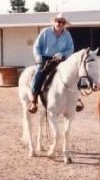
John riding Joe – exactly where he belonged.

There are people who pass through your life, and then there are the ones who leave a voice behind.

The ones who teach you, steady you, challenge you… and sometimes cause just enough chaos to make you pay attention.

John was one of those.

He didn’t lecture. He didn’t sit you down and explain how life worked. He just lived it — fully, unapologetically — and if you were paying attention, you learned.

We rode every morning at seven. No matter the weather, no matter the mood, John showed up. Horses saddled, stories ready. There was always a story. Usually inappropriate. Always unforgettable.

As we rode past the barn and headed down the street toward the trailhead, he’d call out, “Vaya con Dios!” like we were setting off on something far more important than a morning ride.

One morning, Sunshine went down hard in the desert — flat on her belly, sand flying, tack slipping sideways. My 23-year-old former endurance horse didn’t hesitate. She hit the ground, sprang back to her feet, and kept cantering toward the lead horse like nothing had happened.

I never came out of the saddle. Not a stirrup lost, not a beat missed — just instinct and motion carrying us forward together.

When we caught up, I asked John to stop so we could check her and tighten the girth, which had loosened and pulled the saddle off center.

He glanced over with that wry, understated smile of his and said,
“You have good balance, kid.”

It was the closest he ever came to a compliment — and coming from John, it meant everything.

That was it.

No panic. No overreaction. Just quiet acknowledgment — and then we fixed the saddle and kept riding.

That was John.

He didn’t dwell. He didn’t dramatize. He moved forward.

At the barn, he held court like a man who had seen it all — because he had. He could spot trouble before it unfolded, and he had little patience for what he called “repeat offenders.” People who made the same bad decisions over and over, expecting a different outcome.

He didn’t try to fix them. He just observed, shook his head, and let life do the teaching.

There was a kind of freedom in that.

John understood something I didn’t at the time — that you can’t control other people, and you can’t live their lessons for them. You can only ride your own horse.

Years later, when I went to see him, the stories were quieter. The man who had filled every space with laughter now measured his words. Breathing was harder. Time was closer.

He motioned me in, the way he always did, and said something I’ve never forgotten:

“Every time the sun sets, it takes a part of your life with it. Live your life, sweet thing.”

There was no story after that. No punchline. Just truth.

I didn’t understand it fully then. Maybe I still don’t. But I hear it now in different ways — in the quiet moments, in the choices I make, and in the times I catch myself hesitating.

John didn’t teach through instruction.
He taught through presence.
Through observation.
Through living.

John lived his life with no regrets.

And at some point, we all look back and realize one of two things:

we’re either like John — grateful we went for it with full gusto —
or we’re left wondering about the things we never tried.